
Accurately predicting ground shaking is vital for seismic hazard assessment and infrastructure safety. However, infrequent, large-magnitude events are difficult to model due to the paucity of data from ground motion sensors of past events and the complexity of the physics. The ground motions at any given point span a wide range of frequencies and are determined by many factors, including distance to the epicenter, the earthquake’s magnitude, how the fault ruptures, and how seismic waves propagate through extremely variable subsurface environments.
Currently, there are two main approaches, both with limitations: physics-based simulations, which are more accurate, but which are computationally expensive and demand highly detailed information about the Earth’s interior and earthquake sources; and data-driven empirical polynomial-based methods , which are fast, but which often rely on sparse sensor data and struggle to account for local geological complexities. Of course, these two approaches and their limitations are not peculiar to seismology: they appear throughout many scientific domains, ranging from subsurface characterization to fusion, from materials to molecules. Developing principled ML methods to deal with these limitations is a central challenge in Scientific Machine Learning (SciML).
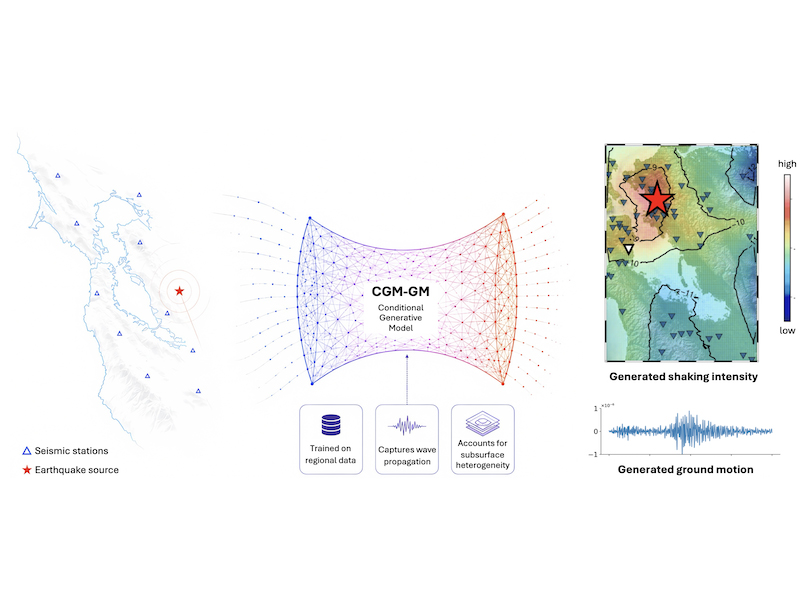
Now, a team of scientists at the Lawrence Berkeley National Laboratory (Berkeley Lab) has introduced a sophisticated machine learning (ML) framework designed to address these limitations. Their technology, called Conditional Generative Modeling for Ground Motion (CGM-GM), needs only a few minutes on a standard computer with a GPU to simulate thousands of earthquake ground motions across the whole San Francisco Bay Area — a task that would require hours of compute time on a costly supercomputing system using traditional computational methods. A paper describing CGM-GM, was recently published in Nature Communications.
The authors developed a methodology that learns the governing physical structure directly from observational data by leveraging an ML model architecture known as a conditional variational autoencoder (CVAE). CGM-GM maps complex seismic inputs, such as magnitude and source-receiver geometry, into a streamlined, lower-dimensional mathematical representation that captures the earthquake’s essential patterns without getting bogged down in raw data. This allows the model to synthesize high-frequency, spatially-continuous earthquake ground-motion waveforms (time-domain data) that implicitly capture the non-linear path effects and heterogeneities of the Earth’s crust – without requiring explicit physical differential equations at runtime.
The CVAE framework is specifically augmented to analyze both the timeline of the shaking and the specific frequencies of the seismic waves simultaneously, using hierarchical latent variables to disentangle global seismic features from local site effects. This structure enables the model to perform “interpolation” in a data-driven sense: it produces continuous field outputs from sparse point-wise observations.
By overcoming the enormous computational requirements of traditional purely physics-based methods, CGM-GM is capable of efficiently modeling the high-frequency ground motions of earthquakes. This is crucial for resilience and engineering safety, and it opens the door to a broader range of practical application.
“While only a few advanced physics-based earthquake simulations can model motions up to 5 Hz, CGM-GM can generate broadband motions up to 15 Hz,” said co-lead author Rie Nakata, a research scientist in Berkeley Lab’s Earth and Environmental Sciences Area (EESA). “This capability is critical because each structure, think about buildings or bridges, responds differently based on earthquake shaking frequencies. Large, tall buildings tend to oscillate at low frequencies while structures such as pipelines are more sensitive to higher frequencies. Having the ability to predict the broadband, what we call a large band of motion frequency, is critical for accurately assessing seismic hazard,” said Nakata.
“The physics-based simulations sometimes cannot precisely describe the real-world dynamics,” said first-author Pu Ren, a postdoctoral fellow in the Computing Sciences Area (CSA). “Our method learns directly from observation data, and it’s better at capturing that complexity. It also provides uncertainty quantification, which is really important in real world applications, especially for risk assessment and decision-making under uncertainty.”
CGM-GM is a compelling example of the benefits of SciML, a rapidly evolving field that seeks to integrate the predictive power of ML with physical principles from domain sciences. While the initial application of CGM-GM was to seismic ground motion, the underlying ML paradigm is highly portable to challenges in other fields, including fluid dynamics, acoustics, and quantum mechanics. For example, this framework could be applied to climate modeling for regional weather prediction, fluid dynamics where simulation of turbulent flow is too costly, or medical imaging where sparse sensor inputs must be reconstructed into high-resolution biological structures.
“We are developing AI, not just using it,” said co-lead author Michael Mahoney, who is AI Initiative Research Lead in CSA’s AI & Learning Systems (AILearn) Group and professor in the department of statistics at UC Berkeley. “If we want to deliver on the promise of AI for Science, then we need to develop cross-cutting ML methods, rather than develop methods that are peculiar to one scientific domain. Importantly, the computational challenges addressed by CGM-GM are not unique to earthquake science. We’re providing something new that’s going to be well-suited for a lot of scientific problems.”
CGM-GM is the flagship for a broader family of models developed by the same group, each tailored to different types of seismic data and geophysical goals.
The CGM-FAS (Fourier Amplitude Spectra) model uses CVAEs specifically designed for problems where the impact can be represented by the magnitude of different frequency components present. The goal of this model is to describe “non-ergodic path effects,” meaning it tries to better capture how seismic energy decreases as it travels through specific, heterogeneous paths in the Earth, rather than using traditional, simplified distance-based models.
The CGM-Wave model uses conditional diffusion models (a different generative architecture than the CVAE model used in CGM-GM and CGM-FAS). The goal of this model is to produce high-fidelity, broadband wavefields from seismicity in the geothermal field.
Ultimately, this line of work underscores a shift in SciML: moving away from “black-box” models that struggle to capture structural laws, and toward generative frameworks that respect the physics of the system by guiding the AI with fundamental physical constraints and relationships it has learned directly from real earthquake data. It also highlights the longer-term scalability of the generative approach: rather than building one universal model that attempts to solve everything, it builds specialized domain-aware “agents” that handle distinct data modalities and/or challenges-waveforms (CGM-GM), amplitude spectra (CGM-FAS), broader wave propagation (CGM-Wave), etc. The common approach underlying the CGM family of models is to replace explicit, computationally-heavy physics simulations with data-driven generative AI, conditioned on key physical observables, an approach with applicability in many scientific domains.
This work was funded by Berkeley Lab’s LDRD program, Statewide California Earthquake Center, National Science Foundation, and the Department of Energy’s Advanced Scientific Computing Research (ASCR) program.
About Computing Sciences at Berkeley Lab
High performance computing plays a critical role in scientific discovery. Researchers increasingly rely on advances in computer science, mathematics, computational science, data science, and large-scale computing and networking to increase our understanding of ourselves, our planet, and our universe. Berkeley Lab's Computing Sciences Area researches, develops, and deploys new foundations, tools, and technologies to meet these needs and to advance research across a broad range of scientific disciplines.