

At the age of ten, E. Wes Bethel realized he wanted to do something with computers. His stepfather, a professor at Purdue University, would drop Bethel off at the computer lab while he taught classes. Hanging out in a room full of terminals, a student approached Bethel and showed him a game that inspired a lifelong passion. “He showed me a very early, black and white vector display version of Battlezone that was being played on these computers back in the early ‘70s, and it totally blew me away. I thought it was so cool that I decided I wanted to do something with computers.”
In high school, Bethel talked with a guidance counselor in a course planning meeting and told them that he wanted to take an electronics shop course. “The guidance counselor looked at me like I was crazy and asked me why I would want to take electronics shop when I was going to attend college.” Bethel explained that in order to work with computers, he would need to learn something about electricity. He went on to study computer science as an undergraduate at the University of Tulsa, where he also completed his master’s degree. “When I got to college, I was the only person in the entire class who, thanks to that shop class, knew how to use an oscilloscope. And I wasn’t afraid of hardware. I was happy to jump in and build stuff. I’ve always felt equally comfortable with hardware and software and that’s been a huge advantage. To write good software you have to understand how hardware works.”
In the first year of his master’s, Bethel took on his first paid industry job writing visualization software in parallel microcode on an array processor with custom hardware to drive a six-foot electrostatic plotter for a small company to perform visualization of geophysics data used in underground oil exploration for companies like Texaco and Pennzoil. “In addition to the electrostatic plotter, there were a lot of other interesting devices, like laser-based film exposing plotters that I wrote custom drivers for. Because the hardware was new and nobody had ever deployed it yet, I had to do field installations in Houston. I would be on the phone with the hardware person and the Texaco people would be standing around me wringing their hands while I made field modifications to the hardware.”
Silicon Valley Calls
In 1987, Bethel loaded all his belongings into a 1969 Volkswagen Beetle and traveled west. He landed in Marin County, where he worked for a small video and animation software company writing some code on early Pixar hardware using a specialized processor for doing image analysis and rendering. One day over lunch a friend mentioned working the summer at Berkeley Lab. Then another colleague recommended Bethel speak to a friend of his who actually worked at the Lab about a potential job. “So I reached out and contacted him, and his name was Bill Johnston. Johnston asked me to come in for a chat and he proceeded to interview me by opening random books off his office bookshelf and asking me about whatever he found on the page.” Bethel passed the test but was told there wasn’t a job available just yet.

Soon after, Johnston’s wife Nancy, who was the group lead of the Lab’s Visualization Group, called Bethel and told him that a new graphics group was being formed. She mentioned that Bill thought Bethel was the right person for the job and asked if he was interested. “I asked how much the pay was and when she told me, I mentioned that I was making about five times that doing freelance work. She said they couldn’t possibly meet that figure, but I decided to give it a try because I was interested in science and in working on their brand new graphics supercomputer from Stellar Computer Corporation.” Bethel started working at the Lab in April 1990. “It has been a lot of fun working with scientists from different disciplines and applying visualization technology to help solve important scientific problems on big machines.”
About five years later, NERSC came to Berkeley Lab from Lawrence Livermore Lab and Bethel landed his first research grant applying virtual reality technology to computational steering problems in earth sciences. “I didn’t really think of it as research, I thought this is an interesting problem that somebody should look at.” After that, knowing that computational facilities were clamoring for it, Bethel tackled making petascale-capable, production quality visualization a reality and conceived and led one of the Department of Energy’s largest open science visualization efforts. “I sat down and thought about it and came up with an idea, put together a team, developed a roadmap and got it funded by ASCR,” said Bethel. “I get a lot of gratification out of doing things that are good for the community and others and this was certainly one of those projects that really had an impact and helped the scientific community.” And with that, in 2006 the award-winning SciDAC Visualization and Analytics Center for Enabling Technologies (VACET) came to be. “Wes has always had a passion for enabling scientists to visualize data that is difficult to understand due to size and/or complexity,” said Deb Agarwal, senior scientist and director of the Scientific Data Division.
Bethel was also a key leader in the lab’s three consecutive wins in the Bandwidth Challenge at the International Conference for High Performance Computing, Networking, Storage, and Analysis (SC) in 2000, 2001, and 2002. The idea was to see how much data you could send from the show floor to an HPC system. In 2002, Bethel developed the Visapult software for volume rendering of data, winning top honors for the “Highest Performing Application” by moving data at a peak speed of 16.8 Gigabits, or 16.8 billion bits of data per second, which was more than five times faster than its own record-setting pace at the SC2001 conference. The team used global clusters of computers located at six sites throughout the U.S., the Netherlands, and the Czech Republic. Entitled “Wide Area Distributed Simulations using Cactus, Globus, and Visapult,” the winning application modeled gravitational waves that typically are generated during the collision of black holes.
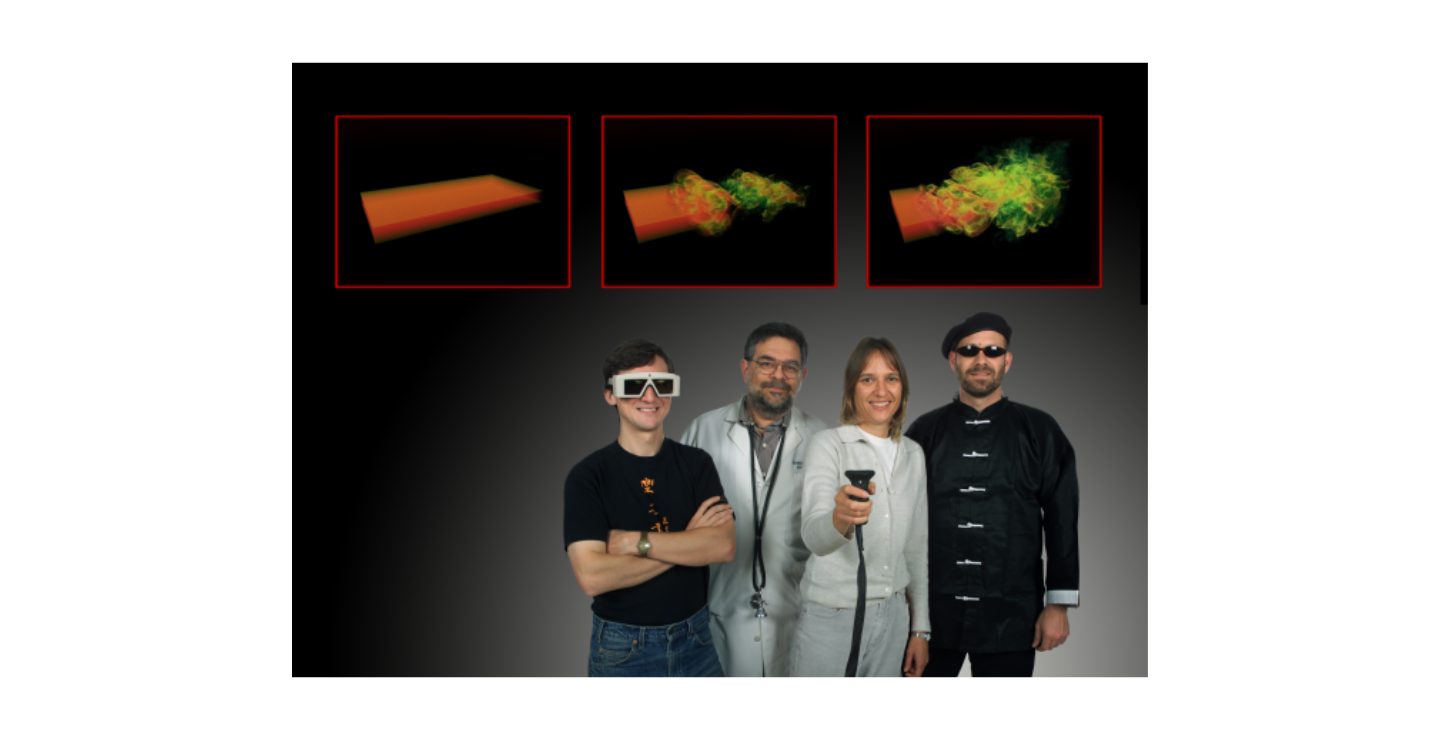
“Wes really started all of that when he led the SC2000 team that won the inaugural bandwidth challenge but passed the torch to me for the 2001 and 2002 BWC teams,” said John Shalf, group lead and department head of the Computer Architectures Group in the Applied Mathematics and Computational Research Division. “The whole time he was super supportive and an integral contributor to the effort. Between the two of us, we won all of the bandwidth challenges from its inception until we retired from the activity in 2003.”
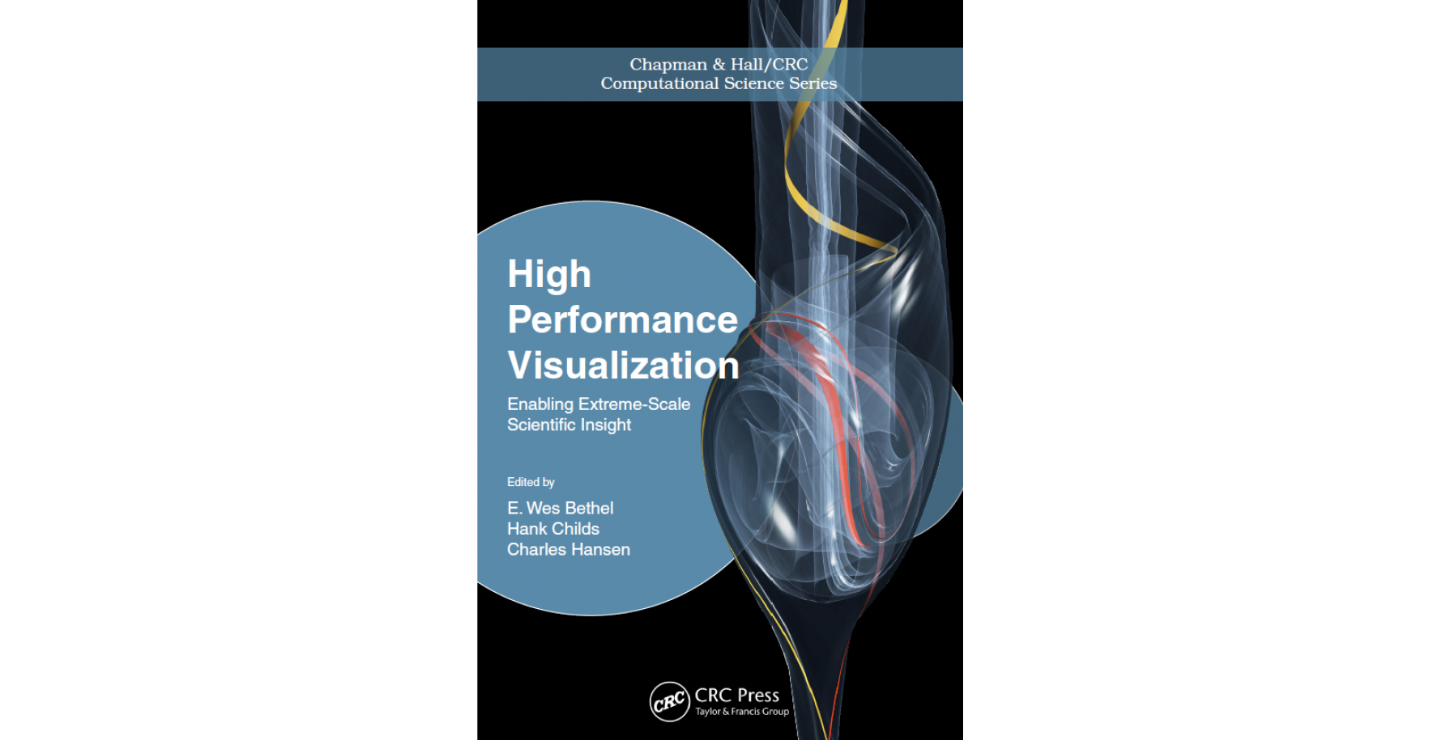
Bethel made several seminal contributions to scientific visualization that are perfectly summarized in the title of the book that he published together with colleagues in 2012: High Performance Visualization: Enabling Extreme-Scale Scientific Insight
“Wes is always pursuing scientific insight,” said Horst Simon, former Deputy Lab Director for Research, and past Director of the Computational Research Division and the National Energy Research Scientific Computing Center (NERSC). “In this pursuit, he was a wonderful collaborator and contributor to NERSC and CRD at Berkeley Lab. I always appreciated his insights and opinions and enjoyed the many conversations that I had with Wes.”
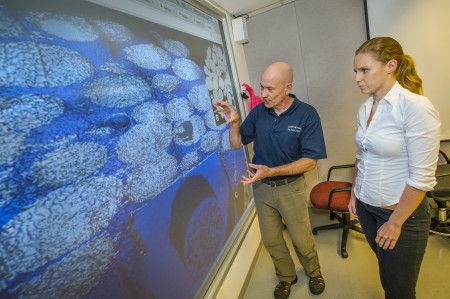
One of the things that Bethel is most proud of is the large number of students and researchers whose lives he has been able to positively impact as a supervisor and mentor. “There were multiple students and staff who ended up as early career award recipients, one who was a Gordon Bell Prize winner, and many others who went on to hold high-level positions in industry,” he said. “They’re still doing AI machine learning image analysis and that sort of thing. This is a very positive thing about working at Berkeley Lab – that we have been able to foster the careers and facilitate the growth of these young researchers.”
Bringing Everything Together
In 2021, Bethel was given the opportunity to work as an adjunct professor in computer science at San Francisco State University (SF State). Shortly after, he began teaching classes and found that he loved interacting with the students and, similar to mentoring at the Lab, helping guide their career paths. “It is really hard teaching at this level, but I have gotten great feedback and it is also really gratifying to work with these kids and see the light bulbs going off in their heads,” said Bethel.
Though he has accepted a faculty appointment at SF State in the computing sciences department, Bethel will remain a part of the Lab community as an affiliate and will continue writing and submitting grants. He looks at his retirement more as a lateral shift where he can focus more on teaching. He pointed out that at SF State they have a Kinesiology department where he can teach collegiate level yoga, taekwondo, and kung fu, and he looks forward to making friends in that department to connect all his passions. “I would highly recommend working at Berkeley Lab for anyone looking for an interesting place to work on collaborative science projects. I am looking forward to maintaining my professional relationships with the Lab so that I can not only be a source of new talent, but I can share what I’ve learned and help others benefit from my years of Lab experience.”
Martial Arts and Yoga
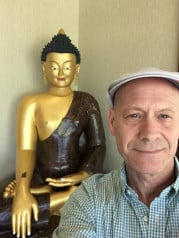
Before he came to Berkeley Lab, Bethel, a black belt martial arts instructor, began to study taekwondo with Dr. Kyung Ho Min at the UC Berkeley Martial Arts program and was able to routinely train with Olympic-caliber athletes, including the 1988 Olympic Gold Medal Heavyweight champion Jimmy Young Kim. “The world-champion UC Berkeley taekwondo program was like a mecca for athletes. People would come from all over the world to train with them,” said Bethel.
Bethel took his first yoga class with the Berkeley Lab yoga club. “I was a rank beginner and I didn’t know what was going on and I just didn’t initially connect with it.” Since then, Bethel found a yoga training center in Marin County where he became a yoga instructor in multiple yoga systems. This eventually led him to become a regular instructor in the Lab’s yoga club, even doing yoga instruction via Zoom during the pandemic.
“I find yoga very helpful for cultivating physical and emotional well-being and it has helped me to learn how to become calm when I am stressed out. Yoga also helps to maintain an open mind and being open to new ideas and unexpected outcomes is another hallmark of science. Unexpected things happen and sometimes the results that you get aren’t what you started out looking for,” Bethel said.
About Computing Sciences at Berkeley Lab
High performance computing plays a critical role in scientific discovery. Researchers increasingly rely on advances in computer science, mathematics, computational science, data science, and large-scale computing and networking to increase our understanding of ourselves, our planet, and our universe. Berkeley Lab's Computing Sciences Area researches, develops, and deploys new foundations, tools, and technologies to meet these needs and to advance research across a broad range of scientific disciplines.