
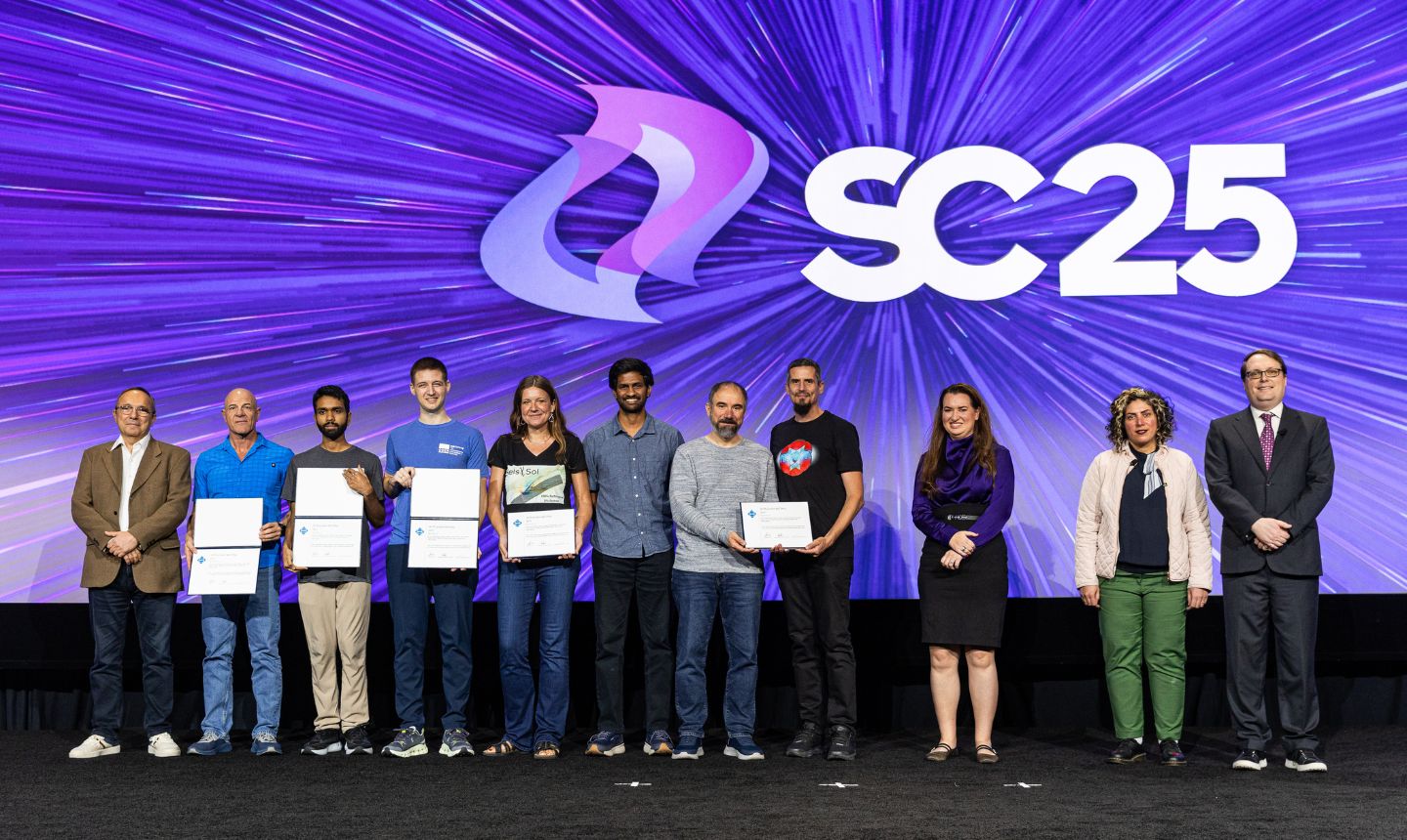
UPDATE: The paper “Real-time Bayesian inference at extreme scale: A digital twin for tsunami early warning applied to the Cascadia subduction zone” has been awarded the 2025 Gordon Bell Prize.
The Gordon Bell Prize recognizes outstanding achievement in HPC; the winners are announced each year at the Conference for High Performance Computing, Networking, Storage, and Analysis (SC). This year, the winner will be announced at a ceremony on November 20.
In the paper “Real-time Bayesian inference at extreme scale: A digital twin for tsunami early warning applied to the Cascadia subduction zone”, a team from Lawrence Livermore National Laboratory, the University of Texas at Austin, and associated institutions present a digital twin enabling real-time, data-driven tsunami forecasting. The model adapts dynamically to real-world seafloor behavior detected by sensors on the ocean floor, offering improved tsunami forecasting and advance warning. The model solved a Bayesian inverse problem with one billion parameters in 0.2 seconds, a ten-billion-fold speedup over previous methods.
NERSC supported this research with a reservation utilizing all of Perlmutter’s GPUs for a period of several hours. Dedicated staff support before and during the reservation, including communication with the science team and proactive system monitoring, ensured a smooth run.
“It’s exciting to see this groundbreaking research honored with a nomination for the Gordon Bell Prize,” said NERSC application performance specialist Muaaz Gul Awan, who attended the reservation along with computer systems engineer Amanda Dufek. “We’re proud to have supported this team and gotten such great results.”
Additionally, in the paper “Advancing Quantum Many-Body GW Calculations on Exascale Supercomputing Platforms”, a team of researchers at Berkeley Lab, the University of Southern California, and associated institutions highlights one of the largest and first-of-its-kind calculations of excited-state properties in complex materials, using the high-fidelity “GW” approach. The researchers used the BerkeleyGW software package on U.S. Department of Energy (DOE) systems, including the Perlmutter supercomputer at NERSC, along with Frontier at Oak Ridge Leadership Computing Facility (OLCF) and Aurora at Argonne Leadership Computing Facility (ALCF), to successfully simulate complex material defect systems of up to 17,574 atoms. The simulation ultimately reached over 1.0 ExaFLOP/s double-precision performance on Frontier, providing a new advanced description of electron, phonon, and optical properties and demonstrating the BerkeleyGW package as a portable, exascale-ready, scalable tool for complex quantum materials simulations at the quantum many-body level.
NERSC supported this work over time through compute time and the expertise of staff, including a long-standing partnership through the NERSC Science Acceleration Program (NESAP), which helps prepare science teams and their workflows for next-generation technology.
“NERSC has played a key role in this work through NESAP and the amazing support of its staff, whether in training, debugging, or performance tuning,” said Mauro Del Ben, a computational researcher in the Berkeley Lab Applied Mathematics and Computation Research Division and an author on the paper. “For BerkeleyGW, this has been a journey over more than a decade, starting on Edison, Cori and continuing through Perlmutter. Thanks to NERSC’s partnership, our users can now fully take advantage of GPU accelerators, achieving order-of-magnitude speedups compared to earlier architectures and significantly boosting their scientific discoveries.”
About Computing Sciences at Berkeley Lab
High performance computing plays a critical role in scientific discovery. Researchers increasingly rely on advances in computer science, mathematics, computational science, data science, and large-scale computing and networking to increase our understanding of ourselves, our planet, and our universe. Berkeley Lab's Computing Sciences Area researches, develops, and deploys new foundations, tools, and technologies to meet these needs and to advance research across a broad range of scientific disciplines.