
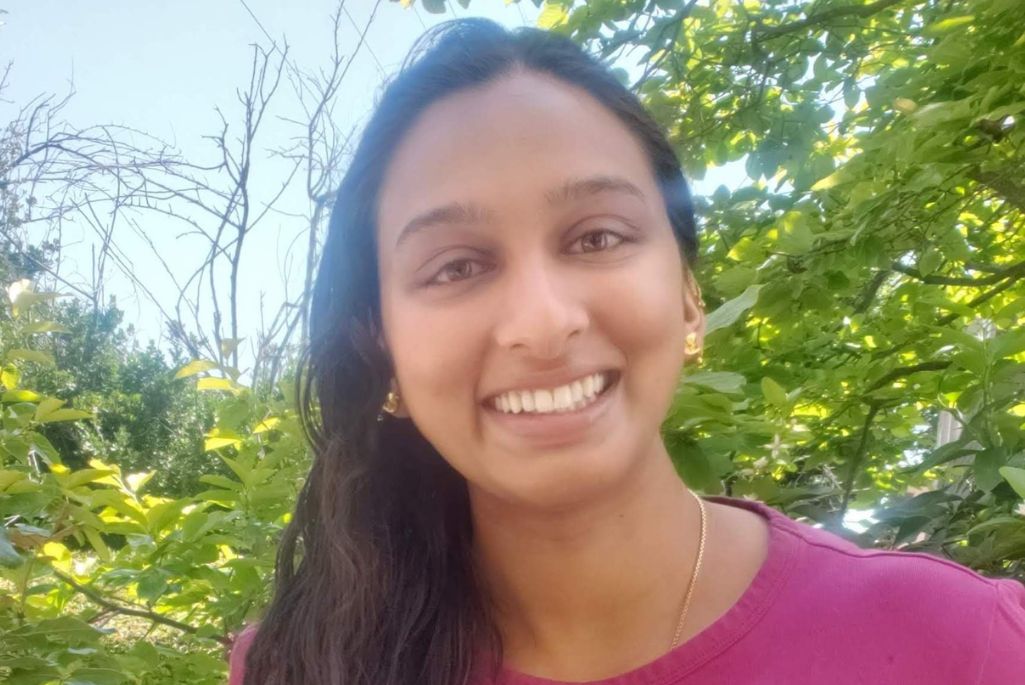
Aditi Krishnapriyan, a faculty scientist in Berkeley Lab’s Applied Mathematics and Computational Research Division (AMCR) and assistant professor at UC Berkeley, has been awarded a prestigious 2025 Department of Energy (DOE) Early Career Research Program (ECRP) award. With this support, she will develop innovative, scalable machine learning methods that enable fast and accurate predictions grounded in real-world science, creating a system that balances accuracy, efficiency, and scalability for complex scientific problems.
Now in its fifteenth year, the ECRP award supports exceptional researchers during the critical stages of their formative work by funding their research for a period of five years.
As modern scientific research increasingly relies on massive datasets generated by advanced computer simulations and cutting-edge experiments, machine learning offers a powerful way to extract insights. However, current methods often face practical challenges when handling large-scale scientific data because they require more computational power than is readily available in practice and can struggle to deliver accurate, physically consistent predictions.
Krishnapriyan’s ECRP project, Accelerating Large-Scale Atomistic and Continuum Simulations with Physically Consistent and Scalable Machine Learning Methods, aims to overcome these challenges by developing machine learning models and frameworks that can efficiently scale as the dataset size and complexity grow. While it’s a common trend to embed physics constraints directly into machine learning models, her research explores whether training models on large, high-quality data allows them to learn these constraints implicitly—a strategy that could lead to even greater scalability. She is also developing methods to speed up predictions while ensuring they remain accurate and consistent with the underlying scientific principles. The project will rigorously validate these approaches across diverse scientific domains characterized by complex spatiotemporal dynamics and significant computational demands, aiming to create a robust framework that balances accuracy, efficiency, and scalability.
“Science currently has access to a lot of simulation data, and machine learning is already helping researchers extract valuable insights and accelerate discoveries. But I believe there’s still untapped potential—especially in developing machine learning methods for simulating large, complex systems over long time scales. For example, simulating transport properties in electrolyte materials or running molecular dynamics or fluid dynamics simulations often involves very large systems and extended time frames. These kinds of simulations can currently take months to produce results relevant to real-world experiments. If we can reduce that simulation time to just a week with high accuracy, it would fundamentally change scientific workflows and speed up discovery,” said Krishnapriyan.
This ECRP award is an extension of Krishnapriyan’s long and distinguished history with the Department of Energy’s national laboratories and research programs. A native of Des Moines, Iowa, she earned a bachelor’s degree in chemistry and physics from UC Santa Barbara in 2014. In 2014, she was a summer student at Berkeley Lab’s Molecular Foundry, and during graduate school at Stanford, she spent part of her DOE Computational Science Graduate Fellowship at Los Alamos National Laboratory working on molecular dynamics sampling methods.
After earning her PhD in computational condensed matter physics and materials science in 2019, she was awarded Berkeley Lab’s prestigious Luis Alvarez Fellowship in Computing Sciences, where she developed and applied machine learning and applied mathematics tools from topology to investigate complex, emergent phenomena in physical systems. She also worked on improving the modeling of partial differential equations, enabling more accurate simulation of scientific phenomena. In 2023, she joined the faculty at UC Berkeley as an assistant professor in the Department of Chemical and Biomolecular Engineering (College of Chemistry) and the Department of Electrical Engineering and Computer Sciences (shared by the College of Computing, Data Science, and Society and the College of Engineering), and she continues her role at Berkeley Lab as a faculty affiliate.
“The Alvarez Fellowship gave me the freedom to explore new areas, discover where machine learning is working or falling short for science and engineering problems, and really shaped the foundation of my research mindset. Having the chance to set my own research agenda was incredibly valuable; being self-directed taught me a great deal about independent problem-solving. My time as a CSGF fellow also offered valuable insight into the DOE’s research community. On campus, it’s been inspiring to collaborate with PhD students who are at the forefront of machine learning for science,” said Krishnapriyan. “Receiving this award is an incredible honor, and I’m hoping that this work not only leads to new collaborations with theorists and experimentalists, but also helps us create the next generation of predictive models.”
About Computing Sciences at Berkeley Lab
High performance computing plays a critical role in scientific discovery. Researchers increasingly rely on advances in computer science, mathematics, computational science, data science, and large-scale computing and networking to increase our understanding of ourselves, our planet, and our universe. Berkeley Lab's Computing Sciences Area researches, develops, and deploys new foundations, tools, and technologies to meet these needs and to advance research across a broad range of scientific disciplines.