
Today’s state-of-the-art quantum computers rely on powerful classical high‑performance computers for control, calibration, and error correction. As quantum processing units (QPUs) grow from dozens to thousands of qubits, the real‑time measurement and processing demands placed on classical central processing units (CPUs) spike. This pressure is intensified because quantum states are sensitive to their environment, typically lasting less than a few milliseconds, placing even greater strain on the already extremely tight feedback loop between the quantum and classical systems.
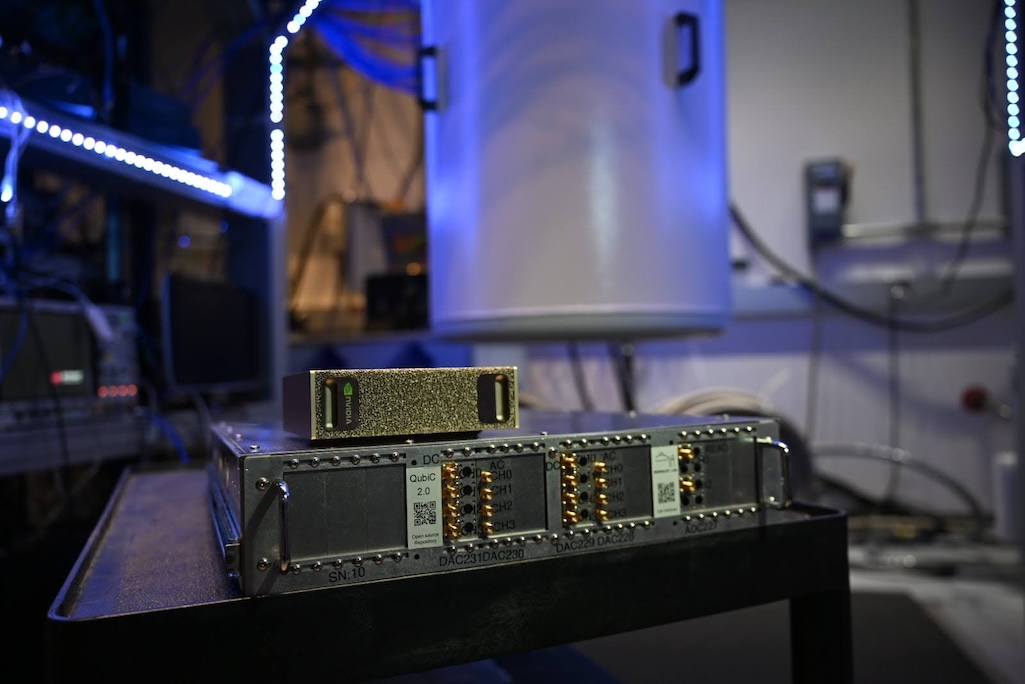
A new collaboration between Lawrence Berkeley National Laboratory (Berkeley Lab) and NVIDIA, announced in October 2025, is working to overcome key challenges in hybrid quantum–classical computing. Its goal is to enable QPUs and graphics processing units (GPUs) to operate together in real time, with shorter delays (latency) and far greater data throughput (bandwidth). The interdisciplinary research team at Berkeley Lab has successfully connected the lab’s quantum control stack for QPUs, QubiC (Quantum bit Controller), to NVIDIA DGX Spark GPU using the NVIDIA NVQLink platform for low-latency, high-bandwidth GPU-QPU communication. Hardware testing is expected to conclude in early March, positioning the collaboration for cutting-edge AI-enhanced quantum experiments that will continue to advance the nation’s leadership in scientific discovery and innovation.
An Open Quantum-GPU Computing Workflow
Funded by the U.S. Department of Energy Office of Science, QubiC is an open‑source control and measurement system that has been deployed and tested at Berkeley Lab’s Advanced Quantum Testbed (AQT) by users from national labs, universities, and industry. Inspired by Berkeley Lab’s expertise in controls for particle accelerators, and supported in part by the Quantum Systems Accelerator, QubiC’s modular framework allows quantum and classical workflow components to be replaced or modified independently. QubiC’s open design philosophy has enabled seamless integration with the NVIDIA NVQLink open system architecture, coupling AQT’s QPU with the NVIDIA DGX Spark.
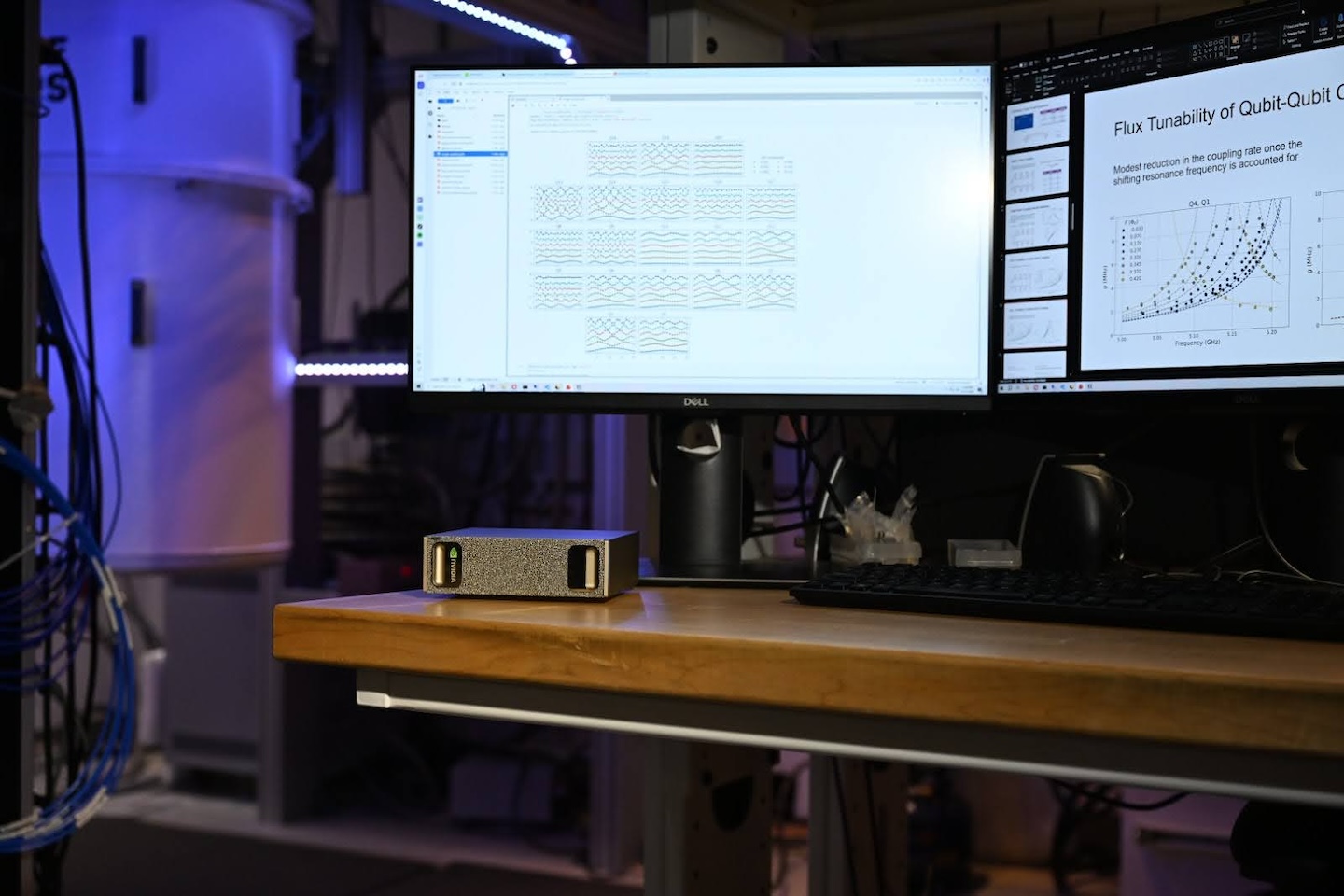
This tightly integrated quantum-classical architecture at AQT facilitates high-bandwidth, low-latency data exchange needed for real-time quantum computing controls. Using a high-speed 100-gigabit networking link, quantum data can flow directly from the QPU to GPU memory with minimal CPU involvement, significantly reducing latency. This efficient feedback loop enables the NVIDIA DGX Spark GPU to analyze results in real time and send updated instructions to the quantum hardware. To push this hybrid architecture even further, the AQT team is integrating NVIDIA’s high-speed networking technology, Hololink IP, into the QubiC gateware to accelerate quantum workloads with classical supercomputing.
“This integration milestone at AQT demonstrates a future where GPUs participate directly in real-time quantum control, enabling researchers to run experiments and error-correction workloads on the same GPU-based platforms used for modern AI and high‑performance computing,” explained Yilun Xu, a research scientist in Berkeley Lab’s Accelerator Technology & Applied Physics (ATAP) Division and co-principal investigator of QubiC.
The Road to AI-Enhanced Quantum Control
Novel quantum experiments at AQT increasingly demand rapid decisions using classical hardware. To meet the broader scientific community’s evolving needs, the QubiC team will continue supporting cutting-edge research through open access and collaboration with industry, academia, and national laboratories. By open-sourcing the QubiC design early in its development and throughout its integration with industry hardware such as NVIDIA accelerated computing, the Berkeley Lab team hopes that other quantum hardware groups will explore GPU-accelerated hybrid quantum–classical workflows.
“By using high-performance networking technologies rather than custom, one-off connections, quantum researchers can scale the approach from a single testbed to large orchestrated systems where a single GPU system can coordinate multiple quantum control boards and experiments using familiar supercomputing tools,” said Gang Huang, key investigator to the development of QubiC and ATAP staff scientist.
Building on the need to integrate quantum computers with classical supercomputers, the next frontier in quantum control is to harness AI. This emerging phase in AI-enhanced quantum control can pave the way beyond small quantum prototype systems with dozens or hundreds of physical qubits toward large-scale quantum computers built from error-corrected logical qubits.
The QubiC team at AQT will continue exploring AI-enhanced quantum control by deploying pre-trained neural network models on the NVIDIA DGX Spark. In particular, they plan to investigate applications such as readout classification, gate tuning, and real-time error correction decoding. They will also test new hybrid quantum–classical algorithms and adaptive techniques to improve quantum computing performance.
Through support from the DOE Office of Science, Berkeley Lab’s collaboration with NVIDIA advances quantum–classical research to enable next-generation discovery. By uniting national laboratory expertise with leading industry capabilities, the collaboration reinforces U.S. leadership in scalable, AI-driven computing. This effort aligns with the goals of the DOE Genesis Mission, which seeks to integrate AI, high-performance computing, and quantum technologies to accelerate the productivity and impact of American innovation.
“Quantum processors are working hand-in-hand with state-of-the-art accelerated computing through the low latency and high throughput connectivity provided by the NVIDIA NVQLink platform,” said Tim Costa, General Manager for Quantum at NVIDIA. “By using NVQLink to run real-time workloads between quantum processors and GPUs, Berkeley Lab is performing the groundwork needed to turn today’s supercomputing systems into tomorrow’s quantum-GPU supercomputers.”
About Computing Sciences at Berkeley Lab
High performance computing plays a critical role in scientific discovery. Researchers increasingly rely on advances in computer science, mathematics, computational science, data science, and large-scale computing and networking to increase our understanding of ourselves, our planet, and our universe. Berkeley Lab's Computing Sciences Area researches, develops, and deploys new foundations, tools, and technologies to meet these needs and to advance research across a broad range of scientific disciplines.