
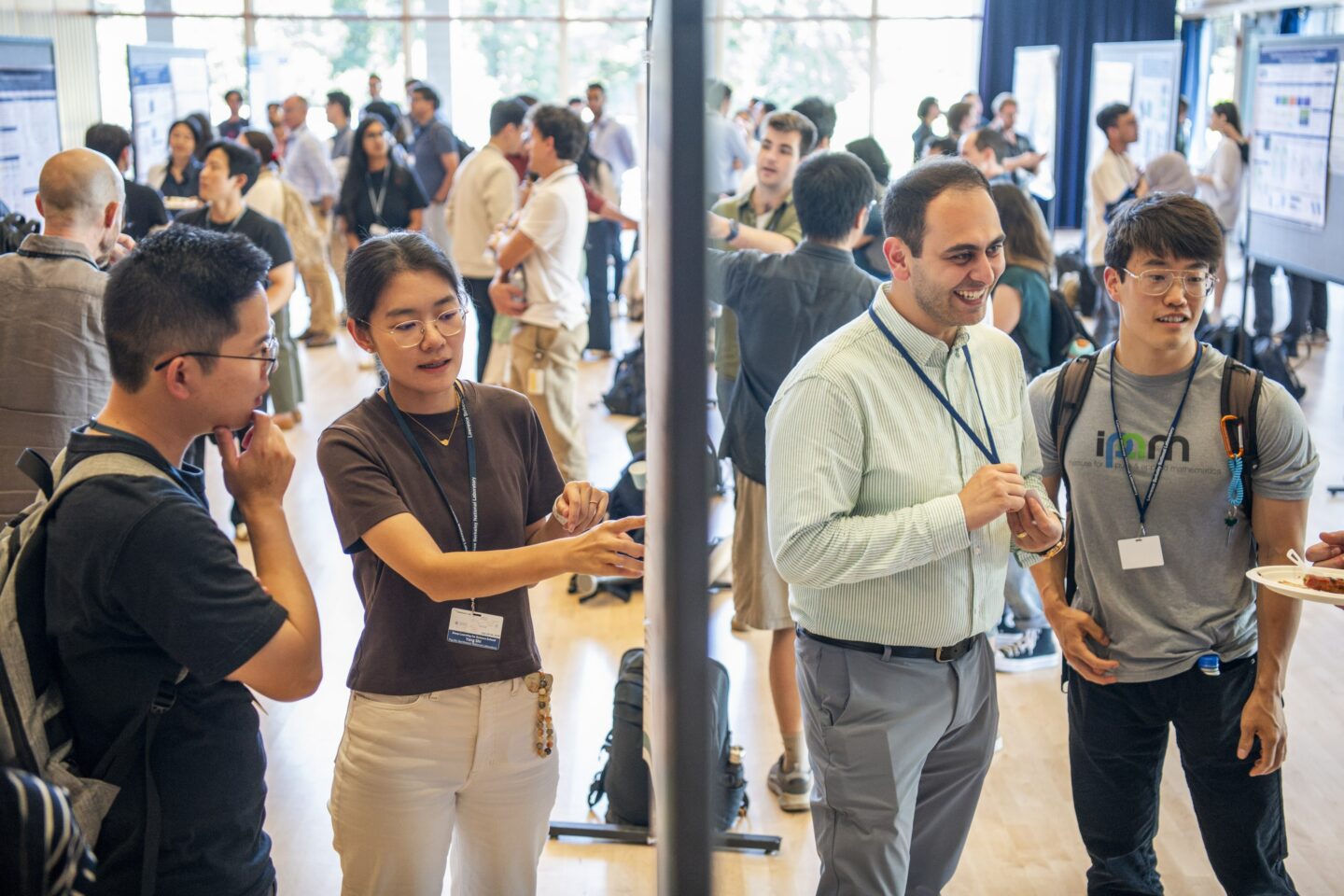
From July 20–24, over 230 researchers gathered at UC Berkeley for the 2026 Deep Learning for Science School (DL4SCI), a five-day intensive workshop featuring the newest and most innovative methods and technologies in AI for science.
Initiated in 2019, DL4SCI has become a benchmark in training researchers in AI, even as it has evolved with the technology. This year’s school featured in-depth lectures and research talks, along with sessions on reasoning-centric workflows and agentic systems.
“The school spans the life cycle of AI in science, from foundation models and large-scale training to scientific applications, reasoning, and agentic AI,” said DL4SCI co-organizer Shashank Subramanian. “Bringing together experts from academia, national labs, and industry gives participants a unique perspective on where AI for science is today and where it’s headed.”
DL4SCI is bolstered by advanced theory in deep learning and generative AI, but organizers say what makes the school special is interaction and collaboration with practitioners using these techniques in real, challenging applications in industry and academia. From conversation with experts to networking opportunities and an optional poster session, DL4SCI is known for offering participants the chance to learn how to apply AI for practical science impacts.
Ultimately, DL4SCI is one important way in which Berkeley Lab is preparing researchers to incorporate transformative technologies into their work and developing the workforce of the future.
“This summer school series has been incredibly effective in bringing deep learning techniques to complex science domains,” said Jonathan Carter, Assistant Lab Director for the Berkeley Lab Computing Sciences Area. “Equipping the next generation of researchers with these capabilities is a vital part to fulfilling the objectives of the Genesis Mission.”
About Computing Sciences at Berkeley Lab
High performance computing plays a critical role in scientific discovery. Researchers increasingly rely on advances in computer science, mathematics, computational science, data science, and large-scale computing and networking to increase our understanding of ourselves, our planet, and our universe. Berkeley Lab's Computing Sciences Area researches, develops, and deploys new foundations, tools, and technologies to meet these needs and to advance research across a broad range of scientific disciplines.