
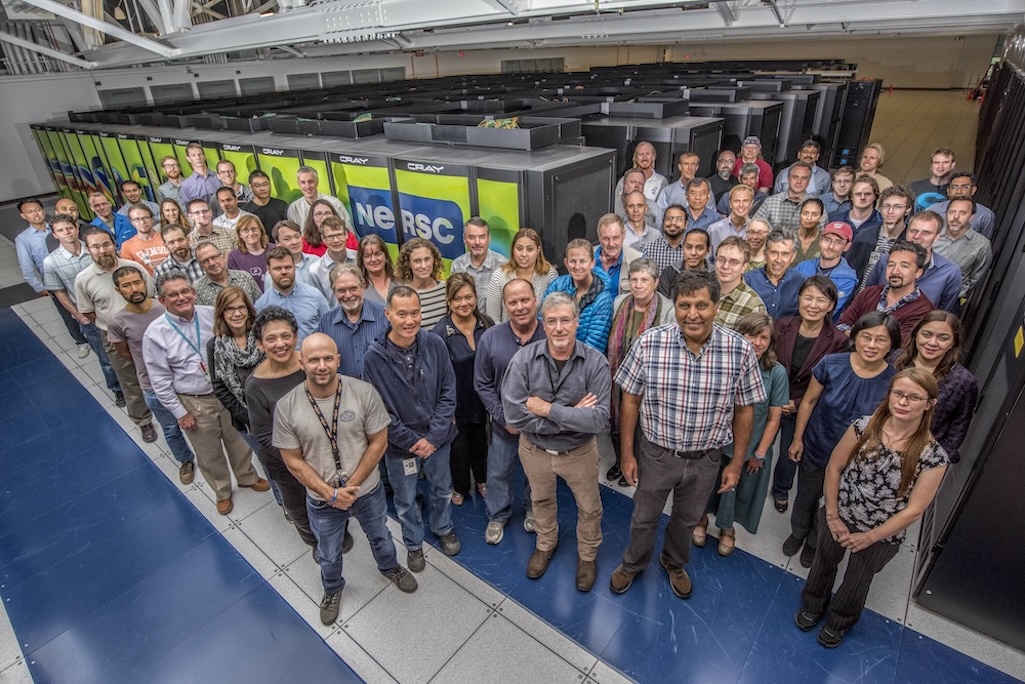
When he retires in January of 2027, three supercomputers and several paradigm shifts later, the center will be actively engaging with pervasive AI and on the brink of deploying quantum computing — technologies considered faraway dreams at the time.
“Sudip leaves behind big shoes to fill. I’ve watched him navigate NERSC through the deployment of world-class supercomputers and major facility upgrades, all while keeping the center at the forefront of scientific computing. He has a rare ability to anticipate where the field is headed and positioning NERSC to lead rather than follow. I’m very grateful for the foundation he’s built for whoever comes next,” said Jonathan Carter, associate laboratory director of Computing Sciences.
Since joining NERSC in 2012, Dosanjh has overseen the deployment of the Edison, Cori, and Perlmutter supercomputers and successfully managed the center’s transition from Oakland to its current home in Shyh Wang Hall at Lawrence Berkeley National Laboratory (Berkeley Lab). More recently, he has served as the executive sponsor and then as the executive project director for the NERSC-10 project, guiding the procurement of NERSC’s next supercomputer through numerous critical stages and paving the way for the Doudna system.
Dosanjh also expanded NERSC’s mission from modeling and simulation to include complex scientific workflows and guided the community through the shift to GPU-accelerated computing. To support this transition, he launched the NERSC Exascale Science Applications Program (NESAP), fostering deep partnerships between application teams and vendors. His leadership also cemented NERSC’s position within the Exascale Computing Project and the Genesis Mission, while his founding of the Monterey Data Conference established a premier venue for AI and data science innovation. It’s this forward motion that’s made NERSC a leader in the field and a sought-after place to work:
“Sudip always pushed NERSC to be the best, and to be interesting, and to push the boundaries, not just provide compute cycles to users. NERSC was the first ASCR HPC center to take interest in big data, and the leader in AI for science. Under Sudip, NERSC is always aiming higher, and that’s why I wanted to work at NERSC,” said NERSC User Engagement Group Lead Rebecca Hartman-Baker, who joined NERSC a few years into Dosanjh’s tenure.
Prior to his time at NERSC, Dosanjh headed extreme-scale computing at Sandia National Laboratories, serving as co-director of the Los Alamos/Sandia Alliance for Computing at the Extreme Scale from 2008 to 2012 and on the U.S. Department of Energy’s Exascale Initiative Steering Committee for several years. Dosanjh also played a pivotal role in establishing co-design as a core methodology for reaching exascale-scale computing. He earned his bachelor’s degree in engineering physics in 1982 and his master’s degree (1984) and Ph.D. (1986) in mechanical engineering, all from the University of California, Berkeley.
About Computing Sciences at Berkeley Lab
High performance computing plays a critical role in scientific discovery. Researchers increasingly rely on advances in computer science, mathematics, computational science, data science, and large-scale computing and networking to increase our understanding of ourselves, our planet, and our universe. Berkeley Lab's Computing Sciences Area researches, develops, and deploys new foundations, tools, and technologies to meet these needs and to advance research across a broad range of scientific disciplines.