
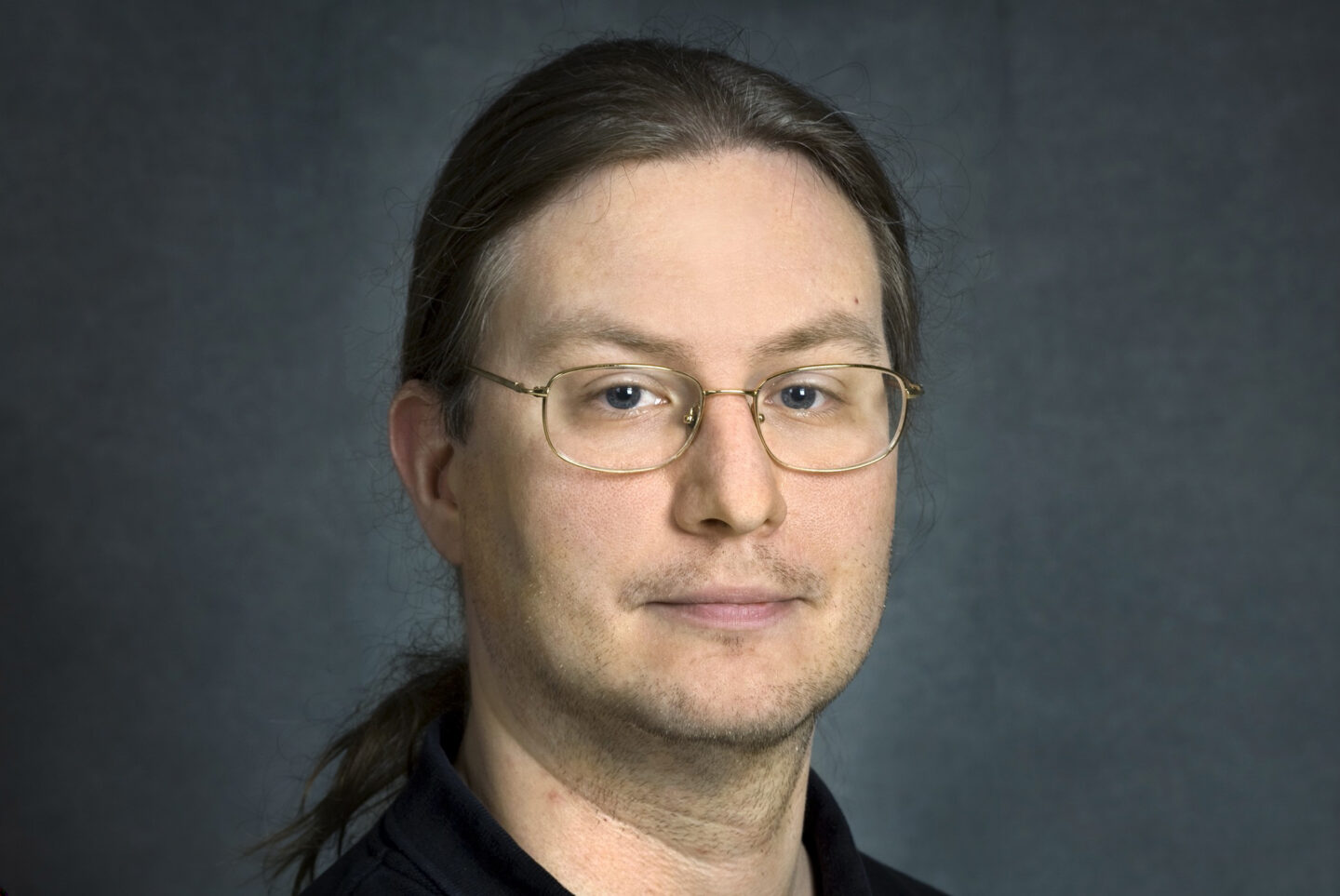
In the summer of 1999, Paul H. Hargrove was a PhD student at Stanford University facing an unexpected gap in his research funding. Looking for a way to pay his rent, he attended a campus job fair and met Bill Saphir, who was then the Future Technologies Group Lead at the National Energy Research Scientific Computing Center (NERSC) at Lawrence Berkeley National Laboratory (Berkeley Lab).
Saphir was recruiting for a project called Modular Virtual Interface Architecture (M-VIA).
“The M-VIA project was looking for a Linux kernel developer, which actually tied into my hobbyist work,” said Hargrove. “While a student, I had written a Linux file system driver for the Hierarchical File System, HFS, used by macOS. Based on that experience, I had the general qualifications Bill needed.”
Hargrove took the position, expecting it to be a brief stint. “My thought that initial summer was, ‘I need money, I’m qualified, let’s do this and get back to the thesis,’” he recalled. He knew that working for a national lab would look good on a curriculum vitae, but didn’t think it would have any other significance in his future career path.
But the following summer, the former technical lead on the M-VIA project had left the Lab. Saphir called Hargrove and asked him to return and take over the role. Having finished his coursework at Stanford, Hargrove rejoined the Lab as a career-track employee. He spent his first 18 to 24 months working part-time—balancing two days a week writing code for the Lab and the rest of the week writing his PhD dissertation—before officially coming on full-time.
Now, after nearly 27 years of building essential high-performance computing (HPC) tools to power scientific discovery, Hargrove will officially retire on October 2, 2026.
An Unlikely Calling Empowers a Generation of Research
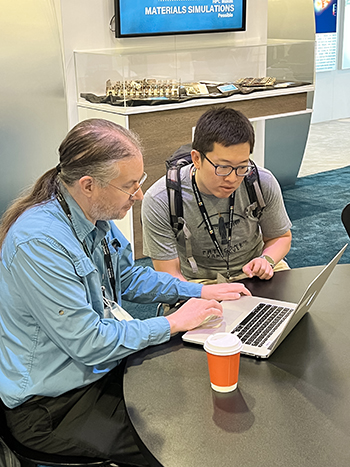
Paul Hargove (left) discusses GASNet-EX at a SC22 roundtable. (Credit: Carol Pott, Berkeley Lab)
Before coming to Berkeley Lab, Hargrove had experience with computer simulations, but he had never worked at the massive scales used by national laboratories. Quickly learning how to work with HPC on the job provided the kind of challenge and independence that convinced him to stay and build a career here.
That independence was also put to the test following a string of management departures. When Saphir also left the Lab, Hargrove was left as the sole staff member on M-VIA and the project’s de facto principal investigator. Shortly after another departure, he even found himself reporting directly to Horst Simon, the former NERSC Division Director.
When the Future Technologies Group, with Kathy Yelick at the helm, was incorporated into the new Computational Research Division in 2001, Hargrove began a long-standing collaboration that would define the rest of his career. He first worked with her to implement Unified Parallel C (UPC) on NERSC supercomputers, learning the nuances of the still-evolving language in order to help build the underlying software it required.
At the time, Partitioned Global Address Space (PGAS) languages like UPC and Titanium, another language Yelick was developing at UC Berkeley, were becoming vital tools for researchers. By allowing programmers to treat the memory of thousands of separate compute nodes as one giant, shared pool, these PGAS languages made it significantly easier to write complex scientific codes.
But despite their potential, they lacked a robust portable implementation. Supercomputer architectures were evolving rapidly, and the existing communication layers were struggling to keep up with the new hardware and with new programming models such as PGAS.
“GASNet grew out of the desire to build one unified communication library that could support both UPC and Titanium, among others,” said Hargrove. “Rather than building a separate communication layer from scratch for every single language, we realized that we needed one stable foundation that could support them all.”
Joining forces with Dan Bonachea, who was then a UC Berkeley graduate student, Yelick’s team built GASNet (Global-Address Space Networking). Designed as a network-independent communication interface, GASNet isolated application developers from low-level hardware details. It allowed complex scientific code to run efficiently on massive systems without scientists having to rewrite it every time a supercomputer was upgraded or replaced—proving to the computing world that researchers didn’t have to sacrifice high performance to achieve high productivity.
What started as a solution for UPC and Titanium eventually became Hargrove’s primary focus for the next 24 years. As supercomputers grew more powerful, GASNet had to scale up alongside them. He helped lead the transition into the exascale era through Pagoda, a project funded by the Department of Energy’s Exascale Computing Project (ECP), which funded the upgrade of the communication software to GASNet-EX to run on next-generation supercomputers. This initiative also funded the development of UPC++, a new programming model that builds upon GASNet-EX and makes it even easier for scientists to use shared memory on exascale supercomputers.
Following a wave of retirements, Hargrove reluctantly stepped away from his technical contributions to manage the Pagoda project. Despite his hesitation, his steady guidance ensured that GASNet and GASNet-EX became the communication backbone for prominent programming models, such as the Chapel and Legion projects, developed respectively by Cray/HPE, and by Los Alamos National Laboratory, NVIDIA, Stanford University, and SLAC National Accelerator Laboratory.
“Those are successes that we can point to as the product of our work,” Hargrove said. “If GASNet had not been available for them to adopt, they would likely have needed to each build something similar themselves. I can’t say they wouldn’t have succeeded without us, but utilizing our software almost certainly allowed them to succeed on a much more accelerated schedule.”
The roots of that success stretch back to the early 2000s, when developers at Rice University and Cray (later HPE) began incorporating GASNet into parallel programming models they were working on, like Coarray Fortran and Chapel, cementing the software’s lasting reputation. It continues today, with GASNet-EX serving as the underlying communication layer for Caffeine, a runtime library that supports the parallel features of modern Fortran for several open-source compilers. With Hargrove’s retirement, his longtime collaborator, Dan Bonachea, will step up as the technical lead for ongoing GASNet-related work, partnering with Principal Investigator Damian Rouson, who leads the CLaSS group in Berkeley Lab’s Applied Mathematics and Computational Research division.
A Legacy Built to Last
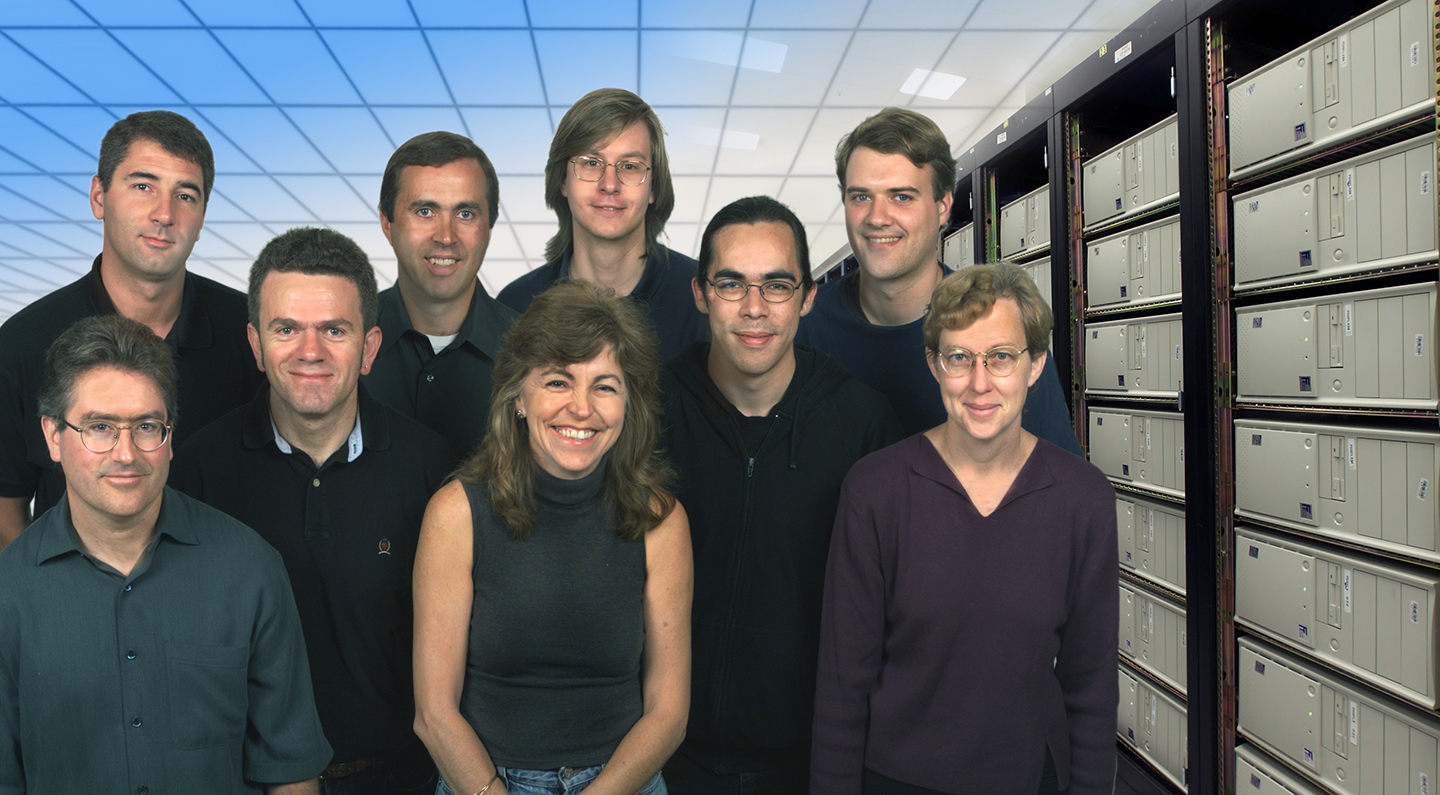
As he looks toward retirement, Hargrove reflects on a 27-year career that almost didn’t happen. It’s a journey that started long before that fateful Stanford job fair.
Born to a physicist father who worked at Bell Labs and the Office of Naval Research, Hargrove developed a passion for science and computers early on. As a child, he loved tinkering with early computers like the TRS-80 from RadioShack and the Apple II series.
“Like a lot of people in my line of work, I am naturally an introvert,” Hargrove said. “Doing something rewarding and creative with a computer was just more my speed. It fit my comfort level as a child, and a quiet hobby ultimately grew to become my career as well.”
That hobby led to a triple major in physics, computer science, and mathematics at Cornell University, and later to his PhD work at Stanford. His doctoral research focused on the simulation of solid-state physics in semiconductor manufacturing. This gave him a deep, technical background that perfectly positioned him to understand the needs of the computational scientists he would later build tools for.
Looking back, Hargrove attributes his long tenure at Berkeley Lab to a series of happy accidents—from needing summer income, to meeting Bill Saphir, to his first boss unexpectedly leaving the Lab.
“It’s an opportunity that fell in my lap,” said Hargrove. “All the pieces sort of fell in a row such that my interest and my abilities aligned with the opportunities.”
But what he built with those opportunities was no accident. When asked what he is most proud of over his nearly three decades at the Lab, he points not to his own code, but to the science it allowed others to do. Several of the codebases that he helped develop went on to be used and funded by agencies far beyond the Department of Energy, including the National Science Foundation (NSF) and Defense Advanced Research Projects Agency (DARPA).
“If someone asks what I am most proud of, it is the multi-decade series of successes by others that our work has enabled,” said Hargrove. “I’ve always viewed myself as a background player in a supporting role. I am proud of enabling scientists to do their research by providing the software that allows them to ask and answer complex questions.”
In retirement, Hargrove looks forward to unpacking the last of his moving boxes at his new home in Las Vegas, taking a retirement cruise with his wife, and making regular trips to San Francisco to visit his 16-month-old granddaughter. And true to his introverted nature, he plans to enjoy a quiet exit.
“I feel honored that the Lab took an interest in doing this profile,” Hargrove joked. “Because I kind of wanted to just quietly move on to start the next phase in my life.”
About Computing Sciences at Berkeley Lab
High performance computing plays a critical role in scientific discovery. Researchers increasingly rely on advances in computer science, mathematics, computational science, data science, and large-scale computing and networking to increase our understanding of ourselves, our planet, and our universe. Berkeley Lab's Computing Sciences Area researches, develops, and deploys new foundations, tools, and technologies to meet these needs and to advance research across a broad range of scientific disciplines.