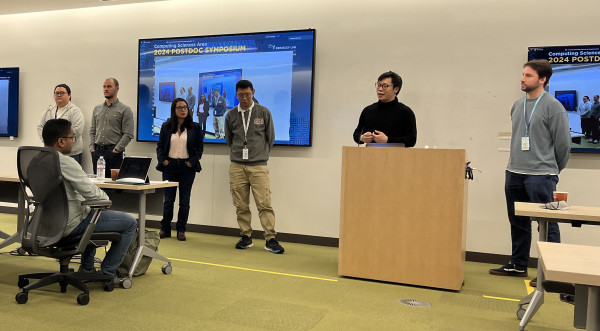
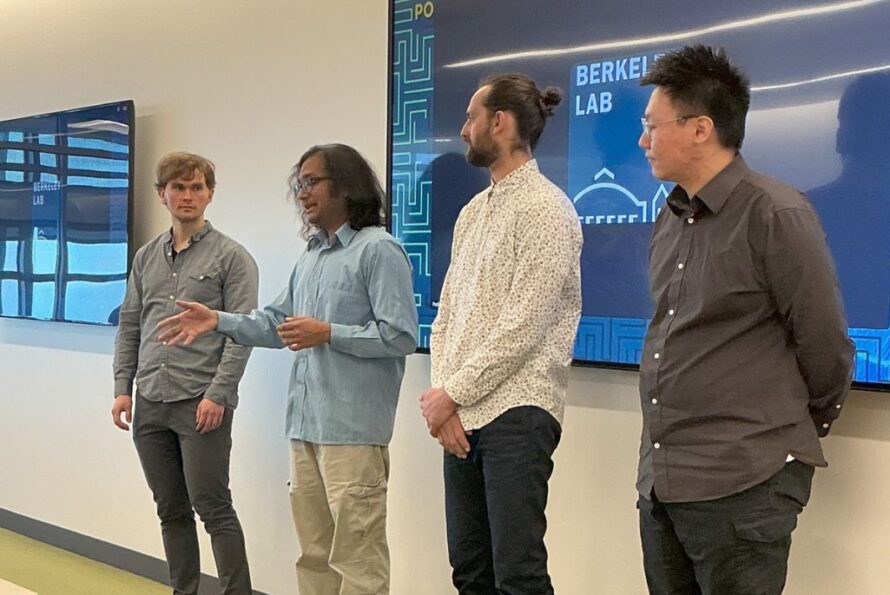
On Feb. 3, 2026, the CSA held its seventh annual Postdoc Symposium at Berkeley Lab, where 13 postdoctoral speakers currently working at the Lab shared 10-minute slide presentations on their exciting projects with an audience of peers, mentors, and coworkers. View their individual presentations below.
“Advances in Tensor Networks for 2D Quantum Systems”
Scalable Solvers Group
Applied Math and Computational Research (AMCR) Division
Morning Session, Group 1
Abstract:
Simulating 2D quantum systems is a major challenge in computational science, with applications from materials design to quantum information. Tensor networks provide a scalable framework that has achieved remarkable success for 1D systems, and extending them to 2D remains an active research frontier. In this talk, I discuss these challenges and present our recent contributions: algorithms for computing low-energy excited states and efficiently sampling 2D quantum states. These advances open the door to exploring complex quantum phenomena and have the potential to enable new scientific discoveries.
“Zatom-1: A Multimodal Flow Foundation Model for 3D Molecules and Materials”
AI & Learning Systems Group
Scientific Data (SciData) Division
Morning Session, Group 1
Abstract: Foundation models in science are attracting an increasing amount of research focus due to their potential to reshape how scientific experiments are performed in numerous domains. In this talk, I will discuss preliminary steps towards the development of a foundation model for 3D molecules and materials science and the open challenges remaining in this research area.
“Estimating Dynamical Correlations in Quantum Many-body Systems through Analog Quantum Simulation”
Applied Computing for Scientific Discovery Group
Applied Math and Computational Research (AMCR) Division
Morning Session, Group 1
Abstract: Dynamical correlations, involving observables evaluated at two unequal times, are crucial for studying transport properties such as diffusion coefficients and conductivities, neutron scattering and dynamical phase transitions. Ab-initio calculation of these correlations is challenging for both classical and quantum computers. We introduce an analog quantum simulation approach for estimating dynamical correlations using time-dependent control sequences as external perturbations. We estimate dynamical correlations obtained from time-evolved observables in the frequency domain via continuous time evolution, using linear response theory. We demonstrate our approach by estimating two-time correlation functions in a 2D array of neutral atoms with Rydberg excitation.
“Continuum Model for Quantum Materials”
Applied Computing for Scientific Discovery Group
Applied Math and Computational Research (AMCR) Division
Morning Session, Group 1
Abstract: The fundamental approach to understanding the electronic properties of materials involves the time-dependent many-body Schrödinger equation, which describes the quantum dynamics of electrons and ions. However, the computational cost of simulating such many-body systems exceeds the capabilities of current computing resources. One way to address this challenge is through the use of continuum models, a specific type of reduced-order model. Significant progress has been made in constructing continuum models for twisted bilayer graphene. However, for twisted bilayer transition metal dichalcogenides (TMDs) heterostructures, the emergence of the moiré pattern arises not only from the twist but also from the lattice mismatch. Moreover, the electronic properties are primarily associated with a specific layer. These features require new techniques and rigorous justification for developing a continuum model that accurately captures the behavior of a single layer in twisted bilayer TMD materials. To address these challenges, we propose an approach to construct a continuum model for the layer that exhibits dominant electronic behavior. To illustrate our idea, we consider a coupled chain model in which the top and bottom layers have different lattices and an energy separation exists between them. This model serves as a one-dimensional counterpart to twisted bilayer TMD materials.
“Fast Computation of Nuclear Strength via Lanczos Method”
Scalable Solvers Group
Applied Math and Computational Research (AMCR) Division
Morning Session, Group 2
Abstract: We present an efficient approach to computing nuclear charge-changing response functions within the quasiparticle random-phase approximation (QRPA). By reformulating the finite amplitude method (FAM) as a linear response problem and introducing a Lanczos-based spectral approximation, we significantly reduce computational cost while maintaining high accuracy across the full excitation spectrum. The method eliminates the need for frequency-by-frequency iteration and enables efficient estimation of both response functions and density of states. Comparative results with GMRES and FAM demonstrate scalability and robustness for large deformed nuclei.
“Accelerating Spatial Queries using GPU Ray Tracing Architecture”
Parallel Performance and AI Nexus Group
Applied Math and Computational Research (AMCR) Division
Morning Session, Group 2
Abstract: Real-time services like ride-sharing apps or maps receive and resolve thousands of spatial queries per second to deliver a smooth user experience. However, traditional spatial tree indexing techniques remain difficult to efficiently parallelize on modern accelerators such as GPUs. Meanwhile, the Ray Tracing (RT) architecture in GPUs, specifically built for tree traversal, remain unutilized. To effectively repurpose RT architecture for accelerating spatial query execution, S-ray introduces several novel reductions by leveraging the rich set of architectural features. Our evaluation provides practical guidance for selecting the most efficient reduction based on workload patterns and application.
“Parallel Estimation of Excited States Using Tensor Trains“
Scalable Solvers Group
Applied Math and Computational Research (AMCR) Division
Morning Session, Group 2
Abstract: The Vlasov-Maxwell equation is a 6+1-dimensional nonlinear partial differential equation that describes the ab-initio dynamics of a high temperature plasma. The dynamical low rank approximation is a reduced-order framework that allows one to compute the dynamics at reduced cost, even making implicit time integration practical. However, most implementations use a split-step time procedure, evolving the Vlasov equation and Maxwell’s equations separately, since that linearizes the equations. In this work we investigate the practicality of implementing a fully coupled time integrator. This talk will provide a brief introduction to the dynamical low rank method, discuss some considerations in implementing the reduced time integrator, and present some preliminary results.
“Stability-Based Sequence Optimization Via Tensor Networks”
Mathematics Group
Applied Math and Computational Research (AMCR) Division
Morning Session, Group 3
Abstract: The design of mRNA sequences is a key computational challenge with broad applications across metabolic engineering, bioengineering, and therapeutics. For a reasonably general set of experimentally informed objectives, I will demonstrate new algorithms that can exactly solve the respective sampling or minimization problems in fixed cubic complexity. I will then describe the efficient computational implementation of these algorithms. Finally, I will show our results for common and impactful real-world problems of sequence design.
“Multimodal AI Models for Building Atomic Models from Cryo-EM Density Maps”
Computational Biosciences Group
Scientific Data (SciData) Division
Morning Session, Group 3
Abstract: Accurately building 3D atomic structures from cryo-EM density maps is challenging, especially for proteins lacking reliable templates, and the problem becomes even more difficult for multi-chain proteins. In this presentation, I will introduce Cryo2Struct, a fully de novo AI framework that integrates a 3D Transformer with a generative Hidden Markov Model to build multi-chain atomic protein structures solely from 3D cryo-EM maps, without using templates or protein language model embeddings. Cryo2Struct is open source, scales to proteins exceeding 5,000 residues, and enables faster, more efficient, and fully automated structure modeling. This approach advances cryo-EM based protein modeling by providing initial atomic models, reducing manual effort, and supporting large, complex protein structures.
“Sparse Tensor Decomposition for Non-Gaussian Data”
Scalable Solvers Group
Applied Math and Computational Research (AMCR) Division
Morning Session, Group 3
Abstract: Non-Gaussian multidimensional data arises in various applications and is often sparse. Tensor decompositions are used to approximate this data by approximating the data tensor via smaller tensors connected in a defined topology. Existing algorithms either do not fit to the non-Gaussian data assumptions or do not scale well for sparse data. We present efficient algorithms to decompose these large-scale sparse tensors. Our algorithms outperform state-of-the-art algorithms for the Gaussian case and generalize to the non-Gaussian data assumptions.
“Zenesis: Empowering Visual Reasoning for Scientific Discovery”
Math for Experimental Data Analysis Group
Applied Math and Computational Research (AMCR) Division
Morning Session, Group 4
Abstract: Across all disciplines, analyzing complex scientific imagery remains a manual bottleneck, often taking experts days. We introduce Zenesis, a universal AI platform that democratizes visual reasoning. Instead of writing code or training models, researchers simply describe targets—like “damaged cells,” “micro-cracks,” or “porous layer”—and Zenesis isolates them instantly in 2D or 3D. By eliminating the need for labeled data, Zenesis achieves 96% accuracy , reducing analysis time from hours to seconds. This breakthrough removes technical barriers, empowering domain experts to focus on scientific discovery rather than manual data processing.
“Zenesis: Empowering Visual Reasoning for Scientific Discovery”
AI & Learning Systems Group
Scientific Data (SciData) Division
Online
Abstract: Flow matching models are state-of-the-art for generative tasks but suffer from inefficient inference. Standard fixed-step solvers ignore the variable complexity of the generative trajectory, wasting computation on simple regions while undersampling complex ones. We propose a data-driven discretization strategy that allocates time steps based on the trajectory’s geometric curvature. By concentrating evaluations where the dynamics are sharpest, our method minimizes geometric truncation error under strict compute budgets. We demonstrate that this simple, inference-only modification improves generation quality over uniform and heuristic schedules without retraining or increasing function evaluations.
2026 CSA Symposium Helps Researchers Amplify Their Scientific Impact

2025 CSA Postdoc Symposium Spotlights Innovation from Early Career Researchers
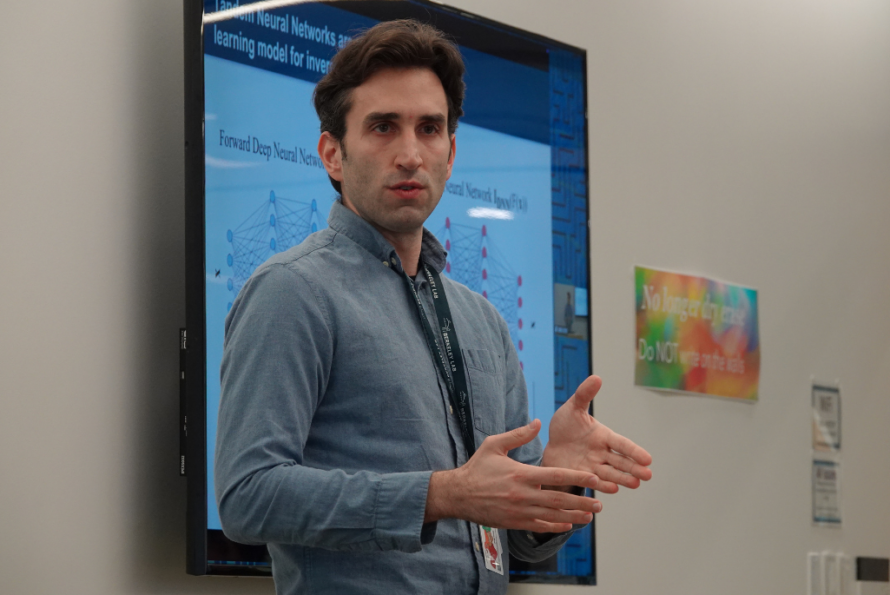
2024 Postdoc Symposium Showcases 26 Early Career Researchers