
New optical materials will be key to future technologies, from new types of sensors and solar panels to powerful quantum computers, but studying and understanding these materials at a microscopic level has proven a scientific and computational challenge. In this new paper, the researchers have opened the door for workflows that could overcome that challenge and reveal exciting new phenomena and cutting-edge materials.
“Now that we have established a machinery that works, we can perform and explain exotic phenomena,” said Mauro Del Ben, a researcher in the Berkeley Lab Applied Mathematics and Computational Research division and an author on the paper. “We can go even further and study even more complex phenomena. It really goes down into the direction of quantum technology with predictive computational capability. ”
The researchers studied moiré superlattices, in which at least two layers of a 2D material are stacked on top of each other with their patterns of atomic arrangement slightly misaligned, either by rotating one layer by a few degrees or by using materials with slightly different lattice structures. This misalignment reveals a moiré pattern similar to those found in certain fabrics and printing effects; in this context, the moiré pattern changes the material’s properties. One of these properties manifests when researchers add or remove a specific quantity of electrons to a moiré superlattice, a process known as doping: the electrons repel each other and form a lattice of crystals known as generalized Wigner crystals.
“The reason this is interesting is that there are many exotic quantum phenomena and quantum orders that exist with a simple twist or simple lattice mismatch,” said Zhenglu Li, Assistant Professor of Materials Science at USC and an author on the paper. “One of these phenomena is the generalized Wigner crystal ground state, where if you put in or remove electrons from these materials, the charges repel each other and form a superlattice structure.”
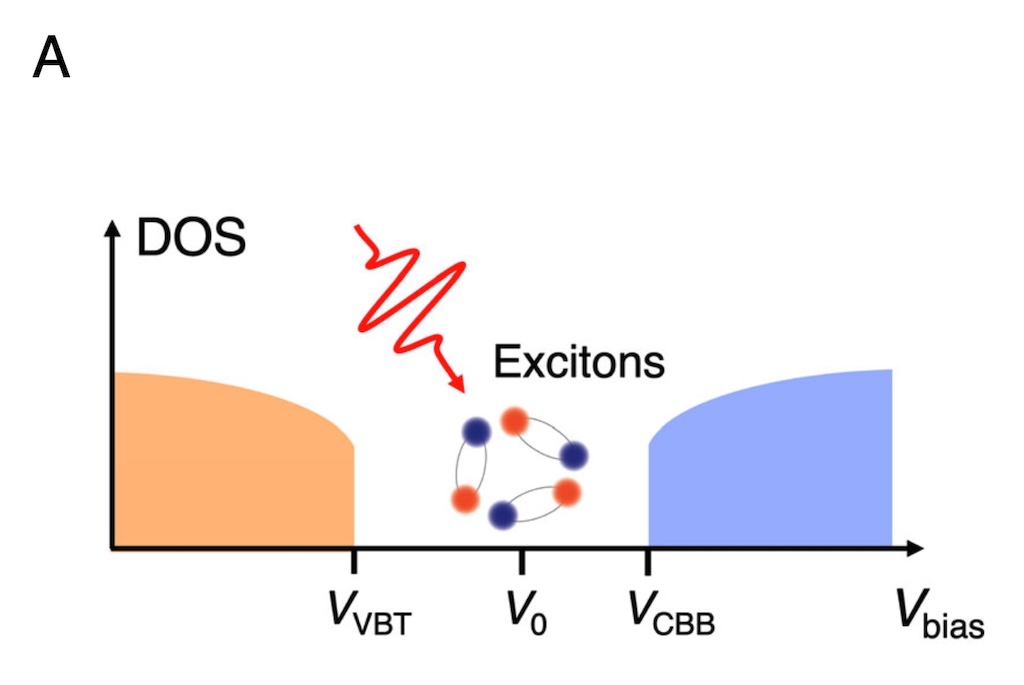
In this paper, the researchers studied generalized Wigner crystals in their excited state—that is, how they respond to light—and found that their structure directly influences how they produce a new type of quasi-particle called a Wigner crystalline exciton. This discovery, from first principles—that is, extrapolating directly from the laws of physics without adjustable parameters—provides proof of what’s previously been observed experimentally, but never described at a microscopic level. Understanding how moiré superlattices respond to light, and why, could be crucial to designing materials for light harvesting, light-matter interaction, solar cells, and other energy-related processes. From there, this knowledge could guide the design of quantum and optoelectronic materials, including platforms relevant to sensing, energy conversion, and quantum information science.
Large scale, high accuracy
Capturing the dynamical behavior of all these particles and how they affect the moiré superlattice is a complex many-body problem, and the researchers wanted to investigate it in a very large material system, as many as 10,000 atoms. With both complexity and scale in mind, they approached the problem using many-body perturbation theory, going beyond the widely used density functional theory (DFT). Many-body perturbation theory is a computationally complex approach that uses intensive computing resources—at a scale that can challenge even the world’s most powerful supercomputers—to achieve highly accurate results.
“The computational challenge is huge because this is a many-body calculation, a very advanced calculation compared with most ground-state applications,” said Li. “Typically, because of this complexity, you either do a very large-scale simulation using a simpler method or you pursue a very complicated method, but with a small system. In this work, we actually achieve both ends. It’s a super large, complicated system with around 10,000 atoms, simulated using a many-body-level excited-states method.”
At this scale, the many-body computation requires an enormous amount of computing power, making use of massively parallel GPU-accelerated supercomputing architectures to process huge quantities of data at once.
“The properties of one of the particles depend on the dynamics of all the other particles, which is why we need to account for the many-body effect,” said Mauro Del Ben. “Practically, that means having a very big function describing the dynamical motion of all the particles in the material. And this very big function has to be processed in parallel by many GPUs, and usually there needs to be communication across GPUs. So one of the technical challenges we have to overcome is how we handle this very large function, this very memory-intensive, compute-intensive object, and how we make sure that we minimize the communication requirement and also the memory requirement to scale up this calculation in a large system.”
To make these large, complex computations possible, the team used BerkeleyGW, a software package developed at Berkeley Lab for many-body excited-state calculations. Since its initial release, BerkeleyGW has used NERSC as its primary high performance computing (HPC) development platform. A key factor in optimizing BerkeleyGW for HPC systems has been the NERSC Science Acceleration Program (NESAP), through which NERSC staff work closely with researchers to adapt and optimize their workflows for advanced computing architectures. First initiated on the Hopper system at NERSC more than a decade ago, BerkeleyGW has grown, adapted, and demonstrated near-peak performance on several different architectures with NESAP support. Currently, a GPU-specific code for Perlmutter and a portable version both allow researchers to use BerkeleyGW on a range of HPC systems, including the exascale systems at Oak Ridge Leadership Computing Facility and Argonne Leadership Computing Facility, where the final computations for this research were completed. The BerkeleyGW team has been nominated as a finalist for the prestigious Gordon Bell Prize for their work twice, in 2020 and 2025.
“Thanks to the support of NERSC, and in particular NESAP, over the last 12 years, we have been able to really push the limit of this software,” said Del Ben.
With new developments in BerkeleyGW achieved in the course of this research, Li and Del Ben’s team created a new computational framework for studying a large variety of excited-state phenomena. Previously, ground-state calculations have been based on non-correlated or weakly-correlated ground states, meaning that the electrons in the materials generally behave independently of other electrons. However, in this new framework, moiré superlattices are considered strongly correlated ground states, forming charge-ordered Wigner crystals upon carrier doping—that is, they behave more like a single entity. With these new developments, the researchers were able to get a more accurate view of how the electrons in the generalized Wigner crystals behave and affect the formation of Wigner crystalline excitons.
Moving forward
A new framework for studying excited states is an exciting step forward, but it’s also a beginning. From here, Li and Del Ben say, the door is open for exploring a range of exotic phenomena found in the doped moiré superlattice and taking advantage of the properties they might find.
“There are many more very exotic quantum ground states found in the moiré superlattice, if you dope it, and we’re working on getting the framework to work on those systems,” said Li. “There are quite a few things to study: you can change the layers, you can change the twisting angle, and you can dope it or apply electric fields. It’s very exciting that we now have this very unique capability.”
Additionally, “now that we have established a machinery that works, we can really perform and explain exotic phenomena,” said Del Ben. “We can go even further and add additional levels of complication to study even more complex phenomena, it really goes down into the direction of quantum technology with predictive computational capability. ”
More broadly, the team plans to take advantage of new ways of working, incorporating complex workflows, AI, and new technologies to make capturing these materials accurately and at scale more efficient. Del Ben says the team plans to take full advantage of the capability of Doudna, NERSC’s next flagship system, to encapsulate these deep, complex steps into a unified workflow and take advantage of the hardware-specific advantages to leverage different facets of the calculation. Due in late 2026, Doudna will be purpose-built for these complex workflows, considered the next evolution in HPC for science.
“The next challenge is figuring out how to take advantage of mixed precision,” said Del Ben. “Do we really need to rely on double-precision arithmetic throughout the calculation, or can we redesign our computational kernels to use mixed-precision algorithms and better leverage emerging hardware architectures? These are the directions we’re exploring as we continue pushing our software to tackle larger, more complex scientific applications.”
About Computing Sciences at Berkeley Lab
High performance computing plays a critical role in scientific discovery. Researchers increasingly rely on advances in computer science, mathematics, computational science, data science, and large-scale computing and networking to increase our understanding of ourselves, our planet, and our universe. Berkeley Lab's Computing Sciences Area researches, develops, and deploys new foundations, tools, and technologies to meet these needs and to advance research across a broad range of scientific disciplines.