News

Mathematical Innovation Advances Complex Simulations for Science’s Toughest Problems
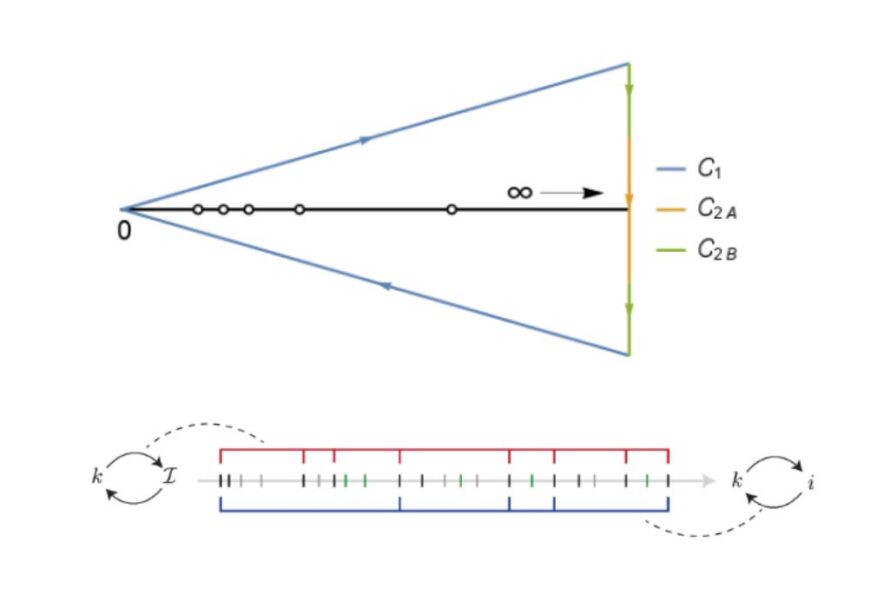
A two-part diagram illustrating a mathematical framework for simplifying complex models. The top diagram shows a V-shaped path of blue arrows enclosing a horizontal line that extends from a point labeled '0' towards an infinity symbol. Small circles along the line represent key numbers describing a system's dynamics. The blue path illustrates a calculation where orange and green segments at the far right can be ignored, allowing scientists to focus on the system's essential features for faster results. The bottom diagram shows a horizontal line with colored tick marks representing a random process visiting different states over time. Above the line, red brackets group larger sets of states into repeating loops, or cycles. Below the line, blue brackets highlight more specific cycles. This illustrates how analyzing these cycles can simplify and speed up complex simulations.

Berkeley Lab Researchers Evaluate Generative AI Models for Filling Scientific Imaging Gaps
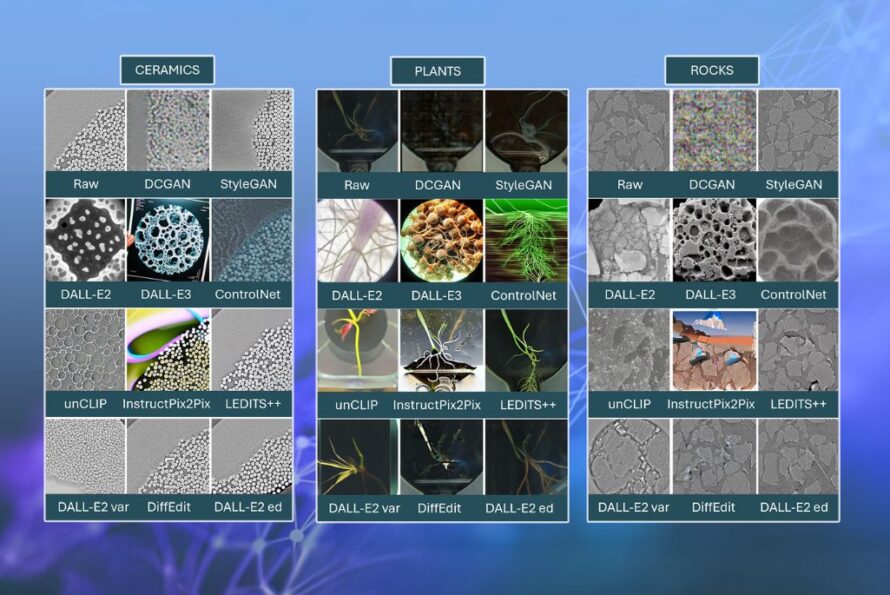
A comparative infographic showcasing the results of different generative AI models in creating scientific images. The infographic is divided into three vertical sections, labeled 'Ceramics,' 'Plants,' and 'Rocks.' Each section contains a grid of images comparing a 'Raw' scientific source image to AI-generated versions created by models including DCGAN, StyleGAN, DALL-E2, and DALL-E3. The 'Ceramics' section shows microscopic views of packed particles, the 'Plants' section displays images of seedlings and root systems, and the 'Rocks' section features grayscale micro-scans of rock sediment, illustrating the varying success of different AI models in reproducing scientifically accurate images.

Unprecedented Perlmutter Simulation Details Quantum Chip
Computing Sciences logo