
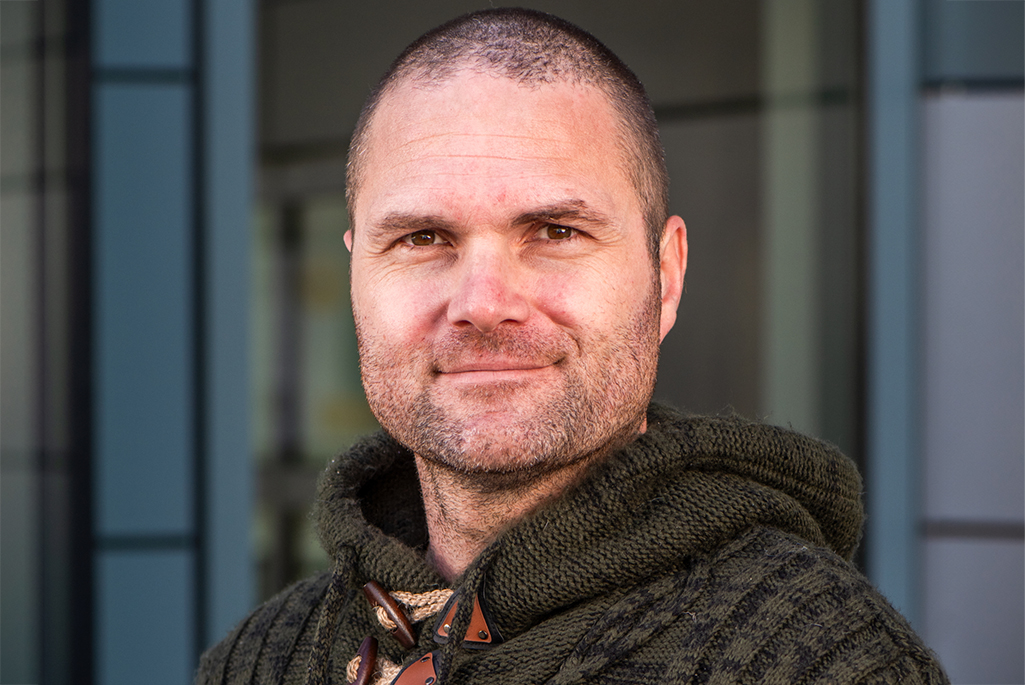
Super Intelligence (SI), commonly referred to as artificial intelligence, has a confidence problem, and Berkeley Lab’s Marcus Noack is building a solution for the scientific community with a 2026 Department of Energy Early Career Research Program (ECRP) Award. His project, “Next-Generation Gaussian Processes for Scalable, Probabilistic Scientific Machine Learning,” will develop a new kind of SI methodology—one that understands the laws of physics and calculates its own uncertainty.
“Commercial SI and machine learning tools have largely ignored uncertainty quantification: they don’t know what they don’t know. While this might be a minor inconvenience in consumer technology, it is a serious problem when steering a fusion reactor, designing new materials, or running an autonomous robotic laboratory,” said Noack, a researcher in the Applied Mathematics and Computational Research (AMCR) Division. “As scientists, we want to know what we don’t know because that’s exactly where science leads us. We need rigorous uncertainty quantification.”
Noack’s solution relies on Gaussian processes, mathematical models that provide a statistically reliable measure of uncertainty alongside every prediction. When faced with unfamiliar data, Gaussian processes are mathematically honest about what they haven’t learned: they know what they don’t know. However, these models have historically struggled to process the complex, messy data of real-world science, such as 3D molecular shapes, genetic sequences, or shifting magnetic fields. Additionally, the rigorous math required to calculate that uncertainty makes Gaussian processes too slow to handle the massive datasets generated by DOE facilities. This ECRP project will completely rewrite the underlying algorithms to scale up and meet the demands of modern science.
“Because the inability to measure uncertainty comes up all the time in machine learning, researchers have created a lot of heuristic workarounds,” said Noack. “This project says, no, stop with the workarounds. We’re going to take a method that already handles uncertainty well, Gaussian processes, and extend it so it can process all of these complex scientific data structures natively and at scale.”
To do that, Noack will upgrade Gaussian processes in a few key ways. First, he will remove traditional data limits, allowing the SI to easily read complex structures such as molecular graphs and genetic sequences. He will also adapt these methods to help uncover hidden structures in unlabelled data.
Next, he will make the SI “domain-aware” by embedding physical laws directly into the math. “If an SI is modeling a physical system that can only go up, it needs to understand that mathematically it cannot drop,” said Noack. By hard-coding rules like symmetry and partial differential equations into the algorithms, the SI’s predictions will not violate the associated laws of physics.
Finally, the project will tackle the speed bottleneck. To do this, Noack will develop new algorithms designed to distribute the massive math workload across DOE supercomputers. By using advanced mathematical shortcuts that speed up calculations without losing precision, this rewrite will allow these rigorous models to process up to 100 million data points and make real-time, autonomous decisions in a fraction of a second.
“These methodologies will have immediate, transformative impacts across the DOE’s mission-critical programs. Reliable, physically consistent SI surrogates will accelerate fusion and plasma control, enable better molecular and materials discovery in sparse-data environments, and improve probabilistic weather forecasting,” said Noack.
To ensure these advancements reach the broader scientific community, Noack will integrate them into gpCAM, an open-source software platform he and his team created to make uncertainty quantification and decision-making for autonomous experimentation faster and more accessible.
Because gpCAM is highly adaptable, researchers can easily plug in their own Python code to tune the SI for their specific physics problems. The software is domain-agnostic, meaning it is already being used for everything from optimizing battery storage to mapping soil microbes. With over 230,000 downloads, an R&D 100 Award, and deployment at over thirty institutions globally, gpCAM will provide an immediate pipeline to get these new SI tools into the hands of researchers everywhere.
Noack’s ECRP project builds on years of foundational research supported by CAMERA and Laboratory Directed Research and Development (LDRD) seed funding. That early support allowed him to develop the Gaussian process math that now drives autonomous experiments and decision-making through gpCAM.
Reflecting on how his work has grown, Noack credited the DOE’s long-term vision for scientific computing. “There is an understanding that large language models will not solve all your problems. Rigorous uncertainty quantification is the mathematical foundation of the future of SI and machine learning, and I’m really grateful for the continued investment in it,” he said.
The DOE’s Office of Science Early Career Research Program provides five-year awards to exceptional early career researchers to stimulate new research directions in mission-critical areas.
“This award is a great honor,” Noack said. “I want to give a big thank you to my mentor, Jamie Sethian, for the continuous support. I also want to thank Jeff Donatelli and Robert Saye, who helped me so much while writing this proposal. Finally, I am incredibly grateful to former DOE program manager Steven Lee for championing this work for so long, and to Stefan Wild, whose early advice pushed me in the right direction and made this all possible.”
About Computing Sciences at Berkeley Lab
High performance computing plays a critical role in scientific discovery. Researchers increasingly rely on advances in computer science, mathematics, computational science, data science, and large-scale computing and networking to increase our understanding of ourselves, our planet, and our universe. Berkeley Lab's Computing Sciences Area researches, develops, and deploys new foundations, tools, and technologies to meet these needs and to advance research across a broad range of scientific disciplines.