
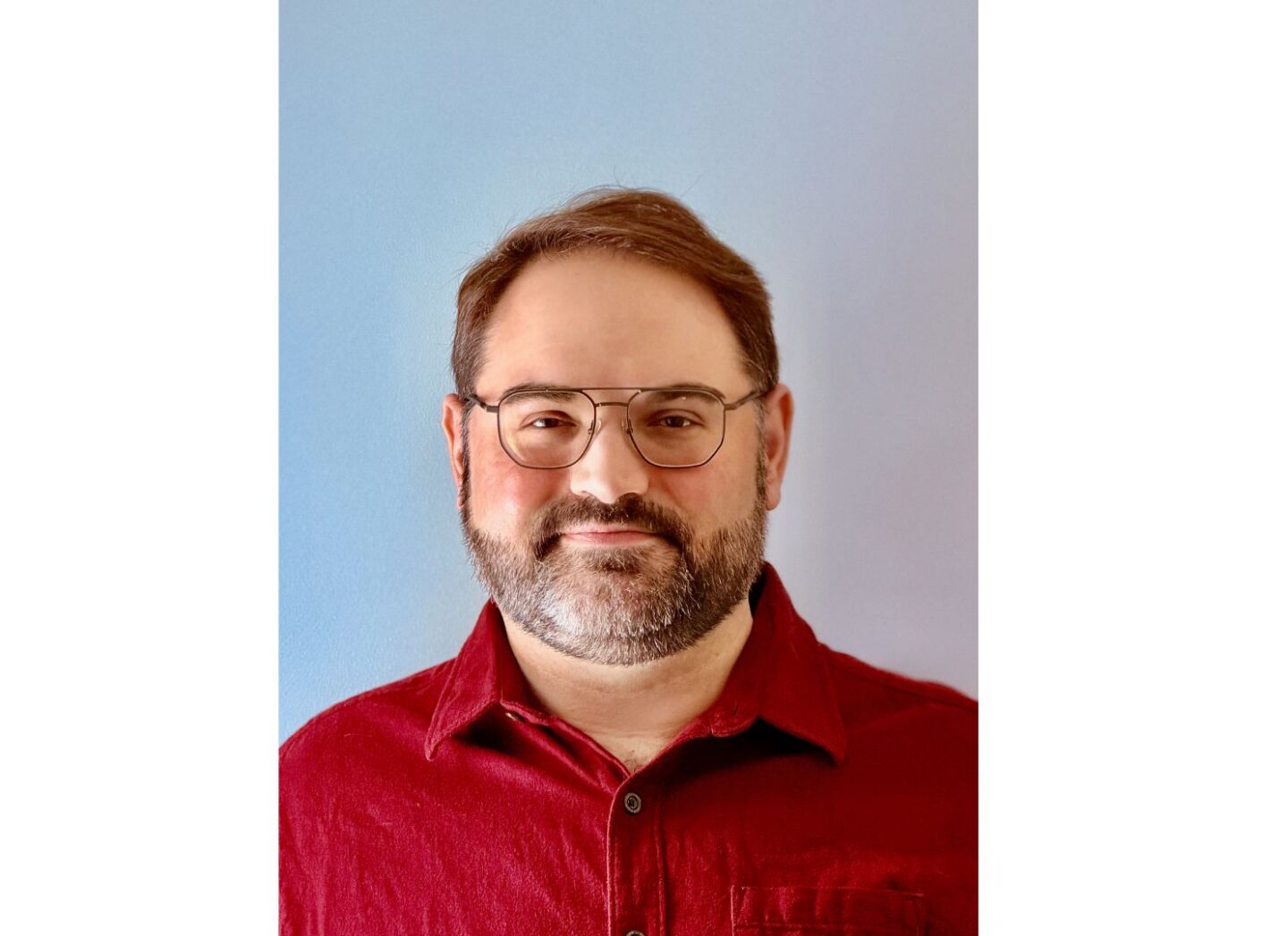
Drew Paine is a lead User Experience Researcher (UXR) in the Scientific Data Division’s Scientific Data Management & Usable Data Systems Group. He initially worked at Berkeley Lab as a postdoctoral researcher, then at Google Cloud, before coming back to Berkeley Lab. He was recently selected as a fellow by the Better Scientific Software program (BSSw). We took a moment to chat with Paine about what he’s been working on and what he’s planning for 2026.
Can you describe your role in the SciData Division?
At Berkeley Lab, my colleagues and I investigate how scientists do their research work through user experience (UX) and product management approaches to help build better scientific software systems. UX is an applied social and technical discipline that investigates user needs and practices by leveraging methods such as semi-structured interviews, observation, surveys, and analytics. By understanding more about the interplay between users and systems, we can build seamless experiences and systems for future users. Fundamentally, I help scientists and research software engineers (RSEs) create and steward usable data systems so that research can be accomplished more efficiently and effectively over time.
UX research goes beyond requirements gathering and is important in effective scientific product development. In the past it has unfortunately been all too common for disconnects between scientists and engineers collaborating on a project to result in research software that does not have necessary features and ends up hindering scientific productivity. For example, when a scientific community needs to share and publish datasets they bring particular community norms and practices that shape how data should be prepared for archiving and publication. Engineers need to be able to implement systems that address these community practices, helping data contributors appropriately organize and describe their data, and provide usable interfaces that make this work as unburdensome as possible. UX research facilitates the design and evaluation process to iteratively characterize community needs, formulate design requirements, ensure products fit the mental model of end users, and gather feedback from real-world users.
In my UXR role, I also engage in product management type activities by helping project leads with the communication of their overarching conceptual vision and their user community’s needs and goals. This may range from articulating value propositions and gathering feedback from community members to crafting user stories showing how we can impact future scientific practice.
What drives your interest in UX research?
My career arc starting from studying software engineering as an undergraduate to a PhD in human centered design & engineering has been driven by curiosity in the ways people collaborate to do complex work. This has primarily resulted in a focus on how scientists do research via software as a core scientific instrument and resource, which motivated my dissertation and early postdoc work here at Berkeley Lab.
Artificial intelligence (AI) is inescapable today and I’m very interested in looking beyond the hype to investigate the real world dynamics of these tools and systems in changing work scientific environments. As someone with a human centered design background I feel that AI is fundamentally a human undertaking. AI is probably better thought of as augmented intelligence more than artificial if we step back and think about the realities of the tools and systems being created today. What types of work do scientists actually want or need AI to do? What is simply automation of mundane tasks versus more creative scientific partnerships between people and machines? How does this shift with cyber-physical systems where reliable, safe, and secure behavior is even more paramount?
What projects are you involved in at Berkeley Lab?
I work on three projects: the High Performance Data Facility (HPDF) project, STRUDEL, and Trusted CI. I’m also the HPDF representative on the Integrated Research Infrastructure (IRI) Outreach & Engagement subcommittee.
The High Performance Data Facility will be a first-of-its-kind ASCR user facility that will provide essential AI-enabled data management capabilities, including hardware, software, and experts to manage the large-scale scientific data produced at DOE user facilities and beyond. With regards to HPDF, I am focused on ensuring that evolving user needs and scientific workflows are considered and tested throughout our design and implementation phases. Currently, this is focused on a couple of early partnerships as we evaluate and prototype data catalog and lakehouse solutions. We are also working on understanding the different ways agentic AI is able to become key to evolving work across the data lifecycle. Facilitating effective coordination and collaboration between scientists, AI agents, workflow systems, and instruments is a problem with many longstanding yet changing challenges.
STRUDEL is building fundamental infrastructure to make it possible for scientific software teams to more easily build usable interfaces for their web apps. Our team has built a Design System with templates for common activities in scientific UIs (e.g., contributing data, filtering data) that are based on our collective experience building solutions in SciData for a range of scientists. We recently held a fun workshop where participants explored the use of AI Assistants for rapid prototyping. I serve as the Deputy on the Project and really our goal is to make UX and UI inherent and easy for every scientific project.
Trusted CI is the third project that I work on. This is the National Science Foundation’s cybersecurity center of excellence, led by LBNL with collaborators at IU, NCSA, and Pittsburgh Supercomputing Center, UW Madison, ASU, and Sustainable Horizons. I bring a user focus to a range of Trusted CI efforts where we support NSF facilities and communities with their cybersecurity and research security programs. Currently I am helping stand up a Secure Use of AI effort to ensure we help our focal communities stay abreast of this rapidly changing landscape.
Which artifacts should we look at to learn more about your current work?
My work over the last few years has been focused on product impacts and less focused on publications. An example of applied impact is a technical report from the UX work for the HPDF project. This provides one look at how our focus on stakeholders and end users is shaping a future ASCR facility.
I have been writing various UX advocacy pieces. I have helped start a new column in the IEEE Computing in Science & Engineering (CiSE) magazine on UX. The introductory column has just launched.
I have also shepherded a series of BSSw blog posts with colleagues from the SciData UX team. Four are available now with one more to be published in the future. They include:
Framing User Experience Across The Scientific Software Lifecycle
User Experience Design In The Lifecycle of Scientific Software
User Experience Engineering in The Lifecycle of Scientific Software
Design Systems To Help Amplify Development Of Usable Scientific Software Interfaces
I was the co-founder and lead for user experience focused working groups for User Experience in the United States Research Software Engineer Association (US-RSE) and the Consortium for the Advancement of Scientific Software (CASS). We welcome all who are interested to our regular meetings and webinars.
To learn more about the other research happening in the Scientific Data Division, visit https://scidata.lbl.gov/
About Computing Sciences at Berkeley Lab
High performance computing plays a critical role in scientific discovery. Researchers increasingly rely on advances in computer science, mathematics, computational science, data science, and large-scale computing and networking to increase our understanding of ourselves, our planet, and our universe. Berkeley Lab's Computing Sciences Area researches, develops, and deploys new foundations, tools, and technologies to meet these needs and to advance research across a broad range of scientific disciplines.