
Breakthrough:
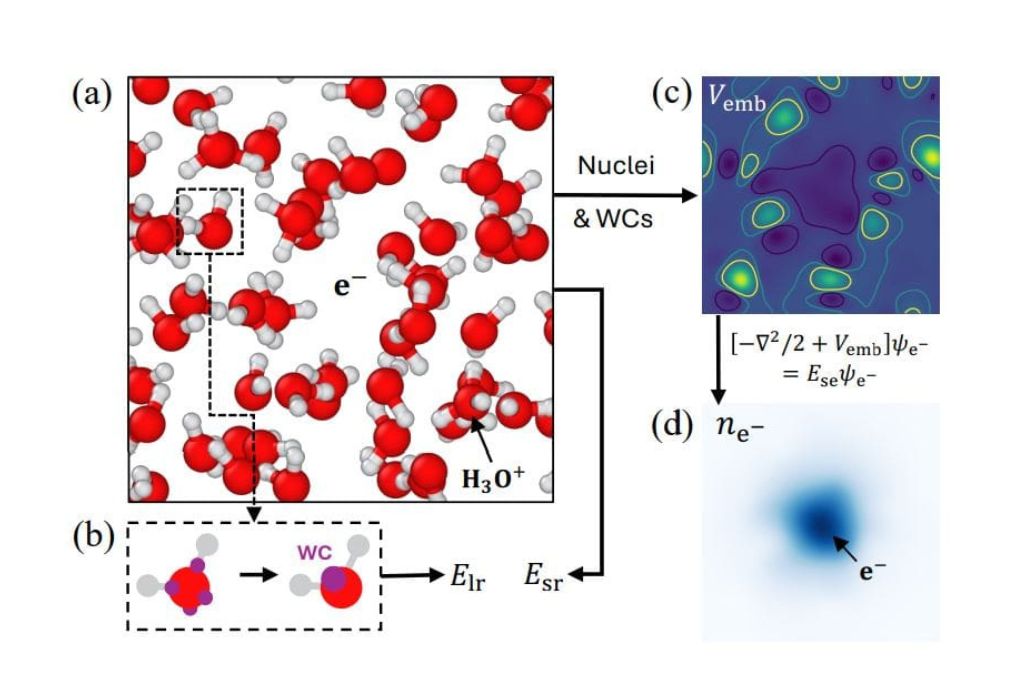
A team of researchers, including Berkeley Lab Alvarez Fellow Pinchen Xie, has developed a groundbreaking computer modeling technique that combines quantum physics with machine learning. This new approach allows scientists to accurately and efficiently simulate how electrons—particularly free or “excess” electrons not bound to atoms—behave and react in water, which is a major challenge in chemistry. In the model, the electron’s motion and interactions are described using quantum mechanics, while the surrounding molecules are handled by a machine learning algorithm trained on advanced quantum calculations. This results in simulations that match experimental observations while requiring far less computational power.
Using this method, the researchers uncovered in detail how excess electrons react with hydronium ions (the main acidic component in water) to form hydrogen atoms, and they precisely predicted the reaction rates and energies. These predictions agree closely with what is observed in laboratory experiments, further validating the technique. This advancement now enables studies of a wide range of vital chemical processes in liquids, paving the way for new discoveries in fields such as energy, biology, and environmental science.
Background:
Simulating how electrons behave in liquids has long been a major challenge in chemistry and materials science. Electrons are fundamental particles whose behavior in chemical systems is governed by quantum mechanics, playing central roles in countless reactions. Yet accurately modeling their quantum interactions—especially in complex, reactive liquid environments—requires immense computational resources, making studies of realistic systems extremely difficult. As a result, traditional approaches often oversimplify electron dynamics or become prohibitively expensive for complex reactions.
This breakthrough combines quantum mechanics with machine learning, enabling computationally feasible and accurate simulations of electrons in liquids. By revealing precise reaction mechanisms and matching experimental results, this method empowers researchers to explore electron-driven phenomena in fields such as energy conversion, catalysis, and biochemistry, opening the door to discoveries that were previously inaccessible.
Breakdown:
To tackle the longstanding challenge of simulating electrons in water, the researchers developed a hybrid method that integrates quantum mechanics with machine learning. The key innovation is modeling the reactive “excess electron” using quantum mechanics, which accurately captures its behavior, while employing a machine learning-trained force field to efficiently handle interactions among the surrounding molecules and ions. This approach preserves quantum-level accuracy where it matters and dramatically reduces computational demands for the rest of the system.
Using this technique, the team simulated how an electron reacts with a hydronium ion in water, uncovering the detailed steps and energetics of the reaction. Their model reliably predicted reaction rates and energies across a range of temperatures, closely matching experimental results. Enhanced sampling strategies and careful validation ensured the simulations remained accurate and realistic, even for rare chemical events. This method now opens the door for scientists to explore complex electron-driven reactions in liquids that were previously inaccessible, advancing research across chemistry, energy science, and biology.
Co-authors:
Ruiqi Gao (Princeton University; former visiting Researcher at Berkeley Lab), Pinchen Xie (Berkeley Lab), and Roberto Car (Princeton University)
Publications:
A Machine Learning Model for the Chemistry of a Solvated Electron
Funding:
Alvarez Fellowship and U.S. Department of Energy (DOE) ASCR Applied Math program. Computational Chemical Science Center: Chemistry in Solution and at Interfaces funded by DOE.
User Facilities:
This research used computing resources of the National Energy Research Scientific Computing Center (NERSC).
About Computing Sciences at Berkeley Lab
High performance computing plays a critical role in scientific discovery. Researchers increasingly rely on advances in computer science, mathematics, computational science, data science, and large-scale computing and networking to increase our understanding of ourselves, our planet, and our universe. Berkeley Lab's Computing Sciences Area researches, develops, and deploys new foundations, tools, and technologies to meet these needs and to advance research across a broad range of scientific disciplines.