
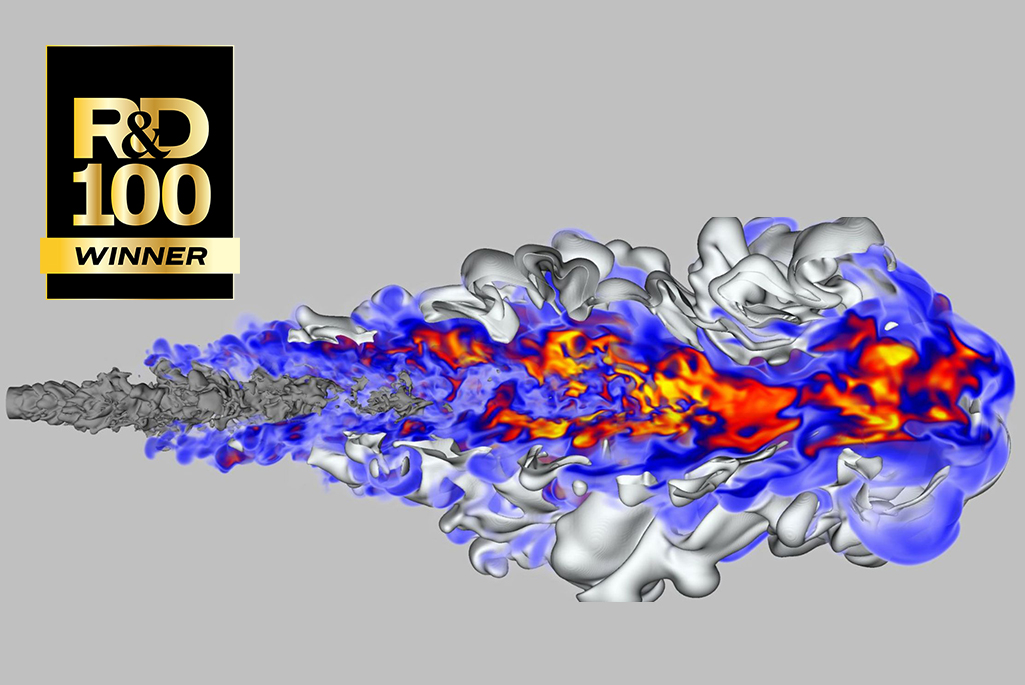
Predicting exactly how fuel burns in heavy-duty engines, gas turbines, and rocket motors is essential to optimizing performance and preventing equipment damage, but running physical experiments in these extreme environments is notoriously difficult and prohibitively expensive.
This is where Pele, an open-source simulation suite co-developed by researchers at Lawrence Berkeley National Laboratory (Berkeley Lab) alongside a multi-institutional team, comes in. Built on the Berkeley Lab-developed AMReX framework and harnessing exascale supercomputing and artificial intelligence, Pele accurately models complex combustion for both low-speed and high-speed fuel-air interactions. By simulating how different fuels perform in these extreme environments, Pele allows scientists to reliably predict real-world outcomes and accelerate the design of next-generation aerospace and power technologies.
The Pele Suite of Exascale Reacting Flow Codes was named a 2026 R&D 100 Awards winner by R&D World in the Software and Services category.
“Being named an R&D 100 winner validates the incredible power of team science. By combining Berkeley Lab’s decades of expertise in adaptive mesh refinement with the deep domain knowledge of our national lab partners, we built a framework that successfully harnessed exascale computing. That collaborative breakthrough is what now empowers researchers around the world to tackle some of the most complex clean energy and aerospace challenges,” said Ann Almgren, Berkeley Lab senior scientist and a contributor on the Pele development team.
The multi-laboratory development effort is led by Marcus Day (National Laboratory of the Rockies (NLR), formerly of Berkeley Lab). It includes partners from Sandia, Oak Ridge, Argonne, and Lawrence Livermore National Laboratories. The Berkeley Lab contingent driving the project includes researchers from the Applied Mathematics and Computational Research Division (AMCR): Ann Almgren, John Bell, Andrew Myers, Andrew Nonaka, Jean Sexton, and Weiqun Zhang.
A Foundation Built at Berkeley Lab
Long before the Department of Energy launched the Exascale Computing Project (ECP) in 2016 to push scientific supercomputing to its next frontier, Berkeley Lab researchers were laying the groundwork for simulating combustion in extreme environments. In the early 2000s, Day, who was then at Berkeley Lab, and Bell created a low-Mach-number combustion code (LMC) built on top of BoxLib, an early software framework for adaptive mesh refinement on CPU-based computers. The team’s foundational work on simulating reacting flows originated in the DOE Advanced Scientific Computing Research’s applied mathematics program and was subsequently enhanced in DOE’s SciDAC program.
That foundational work expanded significantly under ECP. LMC became PeleLM for low-speed flows, while a new solver, PeleC, was added for high-speed flows. Pushing these codes to run on exascale systems revealed a major roadblock: these supercomputers rely on GPUs, whereas BoxLib was strictly a CPU-based framework.
To solve this, a multi-laboratory team led by Bell completely rebuilt BoxLib from the ground up to create AMReX. Today, AMReX acts as the software infrastructure for the entire Pele suite, managing the intricate data and geometry needed to run these massive combustion models.
Modeling the fluid dynamics of combustion is a massive computational challenge because capturing the microscopic details of a flame front requires an incredibly fine, high-resolution grid, but simulating an entire engine block at that microscopic scale would instantly overwhelm a supercomputer. AMReX solves this bottleneck by acting as a highly intelligent numerical microscope. It starts the simulation with a relatively coarse grid. As Pele calculates the fluid motion and chemical reactions, AMReX constantly scans the environment for intense physical activity, such as rapid ignition or steep changes in turbulence.
Instead of forcing the supercomputer to calculate the entire engine block at maximum resolution, AMReX follows the action. It adds higher-resolution grid points specifically where the flame is reacting. As the flame moves, the high-resolution grid moves with it—adding detail just ahead of the flame and erasing it from the space left behind. Focusing computing power only where it’s actually needed cuts simulation costs by 70 percent or more.
Beyond managing the grid, AMReX serves as the crucial translator between Pele’s science and the supercomputer’s hardware. It orchestrates the complex distribution of data across millions of GPUs, thereby offloading a massive logistical burden and allowing Pele’s specialized flow solvers to focus entirely on the complex math of combustion physics. This seamless integration of advanced computer science and physical modeling ultimately enables Pele to operate at the exascale and run some of the largest reacting-flow simulations in history.
In addition to Berkeley Lab, AMReX was developed with contributions from researchers at NLR and Argonne National Laboratory.
About Computing Sciences at Berkeley Lab
High performance computing plays a critical role in scientific discovery. Researchers increasingly rely on advances in computer science, mathematics, computational science, data science, and large-scale computing and networking to increase our understanding of ourselves, our planet, and our universe. Berkeley Lab's Computing Sciences Area researches, develops, and deploys new foundations, tools, and technologies to meet these needs and to advance research across a broad range of scientific disciplines.