
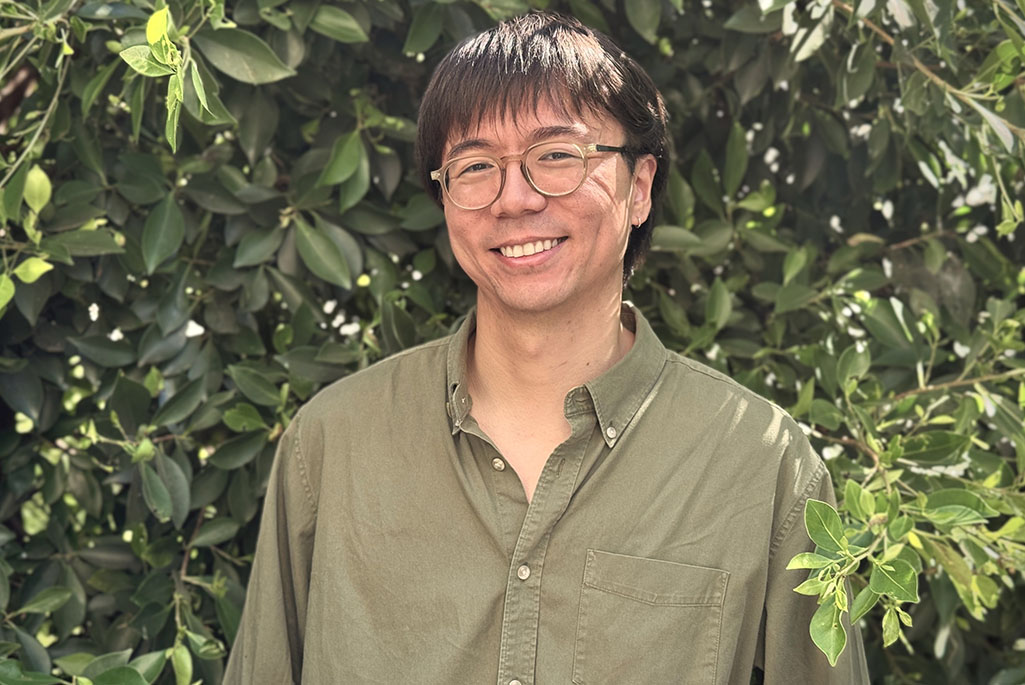
What kinds of scientifically meaningful problems can quantum computers actually solve? Samson Wang will be tackling this question as Berkeley Lab’s new 2026 Luis W. Alvarez Fellow in Computing Sciences. By bridging abstract quantum information theory, near-term quantum algorithms, and practical applications, they aim to map out the true computational capabilities and consequences of emerging quantum hardware.
At Berkeley Lab, they plan to collaborate across fields, leveraging the Lab’s diverse expertise to determine exactly which hard computational problems quantum computing can practically solve. Wang will be working in the Applied Mathematics and Computational Research Division’s Applied Computing for Scientific Discovery Group with Bert de Jong.
When asked what drew them to apply for the fellowship, Wang pointed to the Lab’s collaborative environment. “Berkeley Lab seems like a very exciting place to work,” they said. “I’m really looking forward to interacting with the wealth of expertise in the computational sciences here. Getting to converse with lots of folks in other fields who are solving hard computational problems will be so valuable for my research.”
Wang’s academic journey reflects a natural evolution of their curiosity—from a desire to understand the universe to the highly specific realm of quantum computation. During a combined bachelor’s and master’s physics program in the U.K., their drive to learn how the universe works drew them to the fundamental and peculiar rules of the quantum world. This led them to pursue a Ph.D. at Imperial College London under Mario Berta, where their research initially focused heavily on abstract quantum information theory.
Over the course of their Ph.D. studies, Wang’s interests pivoted more toward computation. The growing excitement around actual, physical quantum devices inspired them to bridge deep theoretical questions with practical, real-world impacts. This shift toward quantum algorithms and near-term computing guided their subsequent research roles. Driven to explore these emerging applications, Wang served as a visiting researcher at IRIF in Paris, working with Simon Apers, and most recently as a postdoctoral researcher at the Institute for Quantum Information and Matter (IQIM) at Caltech.
Long before they discovered physics, Wang grew up in London with a deep love for the arts, particularly painting and drawing. Today, they continue to bring that creative, explorative mindset to their life and research.
“I was quite an artsy kid growing up and wasn’t super engaged in school until I started watching Carl Sagan documentaries around age 16,” said Wang. “Something suddenly clicked. I realized he was talking about exploring the deep, hidden beauty of how our world works, which complements the aesthetic and poetic beauty that I knew, and that I could learn about all of that in school. It was amazing to get to study the world in this way, and I became engrossed in science.”
Outside the lab, they are looking forward to exploring Northern California’s natural beauty through hiking and cycling, and to continuing to expand their art skills, with a particular focus on the complex challenge of drawing hands.
Established in 2002, the Luis W. Alvarez Fellowship honors the pioneering physicist who foresaw the power of computers in scientific research. Supported by the Department of Energy’s Office of Advanced Scientific Computing Research applied mathematics program and Berkeley Lab’s Laboratory Directed Research and Development program, the fellowship empowers exceptional Ph.D. graduates to take on grand challenges in computing sciences. Over two years, Alvarez Fellows collaborate on advanced computational and mathematical projects across fields like materials science, biology, energy, and genomics—building professional connections and launching impactful scientific careers at Berkeley Lab and beyond.
About Computing Sciences at Berkeley Lab
High performance computing plays a critical role in scientific discovery. Researchers increasingly rely on advances in computer science, mathematics, computational science, data science, and large-scale computing and networking to increase our understanding of ourselves, our planet, and our universe. Berkeley Lab's Computing Sciences Area researches, develops, and deploys new foundations, tools, and technologies to meet these needs and to advance research across a broad range of scientific disciplines.