
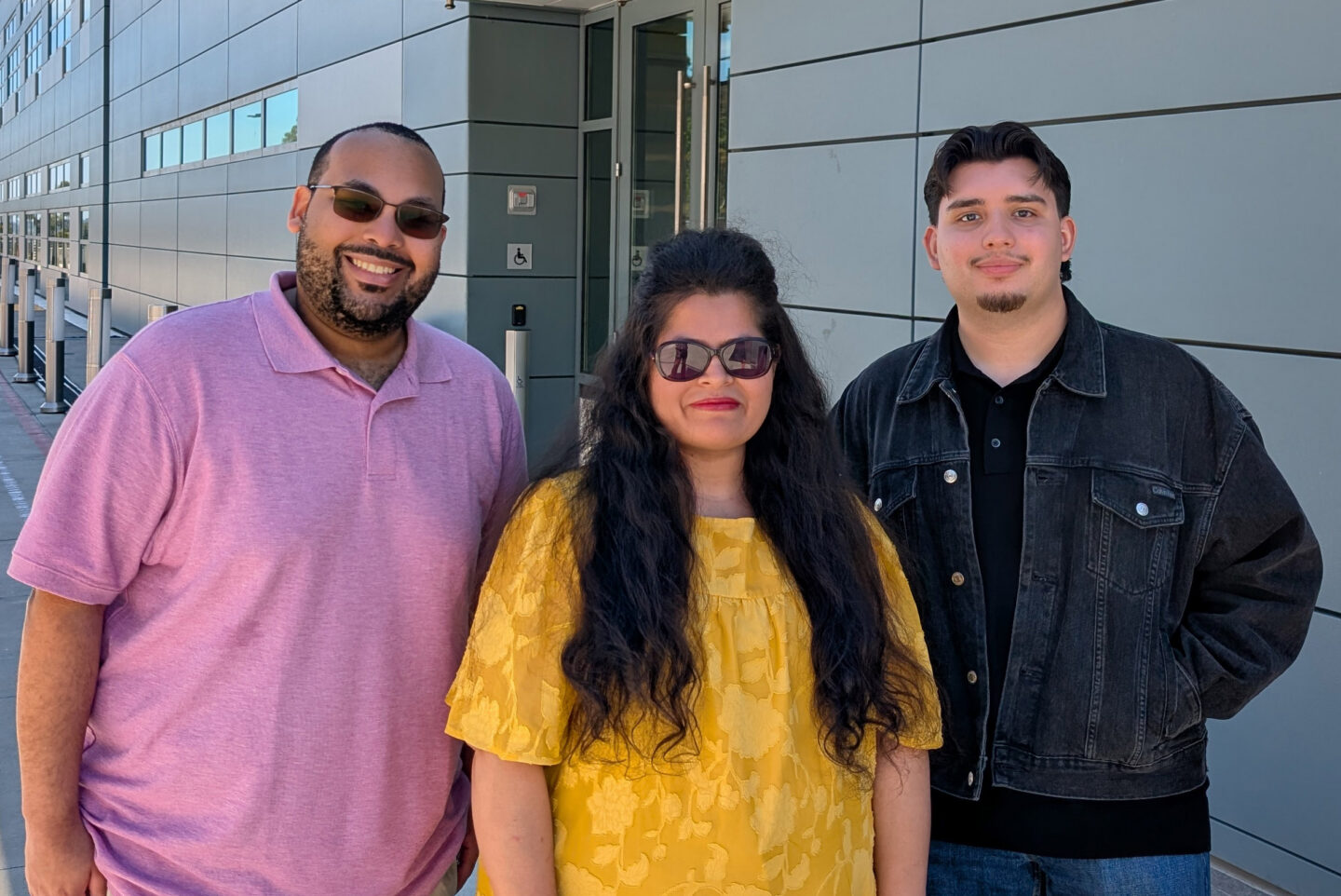
Seven years after her own pivotal internship in high-performance computing (HPC) at Lawrence Berkeley National Laboratory (Berkeley Lab), Naw Safrin Sattar returned this summer—now as a mentor, bringing along Meharry Medical College graduate students David Reyes and Evan Browne.
For Sattar, this was a full-circle moment: she and her students spent the past two months working on an AI-driven research project with Khaled Ibrahim, a researcher in the Applied Mathematics and Computational Research Division (AMCR), the same scientist who mentored her as a graduate student intern back in 2019.
“My summer internship at Berkeley Lab helped confirm my decision to pursue a research career in HPC and showed me what a future working at a Department of Energy (DOE) national lab could look like. I liked this environment quite a bit,” said Sattar, who is now an assistant professor of HPC at Meharry Medical College. “That summer, I had amazing opportunities to meet people who continued to serve as mentors for me. This experience inspired me to come back to Berkeley Lab and bring students with me, because coming here opened up so many doors for me, and I want my students to gain those same opportunities.”
Mentorship is a Win-Win Philosophy
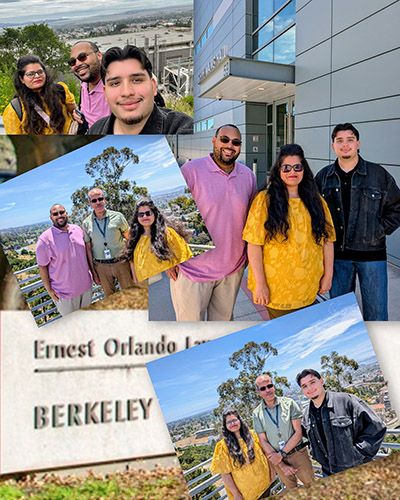
A collage of photos featuring Meharry Medical College Assistant Professor Naw Safrin Sattar and her graduate students Evan Brown and David Reyes who conducted research at Berkeley Lab this summer, alongside AMCR Researcher Khaled Ibrahim.
For Ibrahim, serving as a mentor is a natural extension of his own career journey and a way to tap into the new energy that visiting researchers bring to the lab.
“Navigating a research career typically requires people giving us a hand, and I benefited from that enormously during my career. I view opportunities like DOE’s Visiting Faculty Program (VFP) as a good way to ‘pay back’ this debt to the next generation,” said Ibrahim. “But more than this, it is also an extremely rewarding experience for me. I not only get to help people, but these researchers bring fresh ideas and new perspectives that can transform the research.”
This win-win dynamic is what sparked Ibrahim’s 2019 partnership with Shaikh Arifuzzaman, Sattar’s PhD advisor from the University of New Orleans. The two met at a matching workshop as part of the Sustainable Research Pathways (SRP) program, an annual event designed to connect academic faculty and student researchers with scientists at the Lab. Following the match, Berkeley Lab-funded projects supported the student and the faculty team to come to Berkeley Lab for their summer 2019 internship.
It was there that the researchers found a perfect intersection for their work. Sattar and Arifuzzaman were interested in dynamic, or temporal graphs—mathematical models used to map complex, ever-evolving systems, like intricate molecular interactions. Though not a graph analytics expert himself, Ibrahim saw how his expertise in parallel algorithms and HPC could help scale up their research.
Because real-world scientific networks are massive, traditional analysis methods often fall short. Together, this team decided to spend that summer tackling the challenge of community discovery within these fluid environments. Their research focused on tracking how communities emerge and evolve, and on rigorously evaluating various computational methods to determine the most effective way to process large-scale, time-sensitive data.
“Safrin [Sattar] was well-versed in developing graph algorithms,” said Ibrahim. “I helped with the HPC aspect—how to leverage HPC resources to solve these kinds of problems efficiently. Graph analytics are typically very challenging for HPC resources, so it makes it both a challenging and an interesting problem.”
“Before that summer, my PhD research had been limited to analyzing static graphs on a local university computing cluster,” said Sattar. “Partnering with Khaled [Ibrahim] allowed us to tackle dynamic, ever-changing graphs. Getting access to NERSC supercomputers and learning how to leverage HPC tools was a complete game-changer that pushed my research forward.”
This mentorship experience lasted long after the initial 10-week summer project. Following the internship, Arifuzzaman invited Ibrahim to serve on Sattar’s PhD dissertation committee, and their continued collaborative research resulted in several publications.
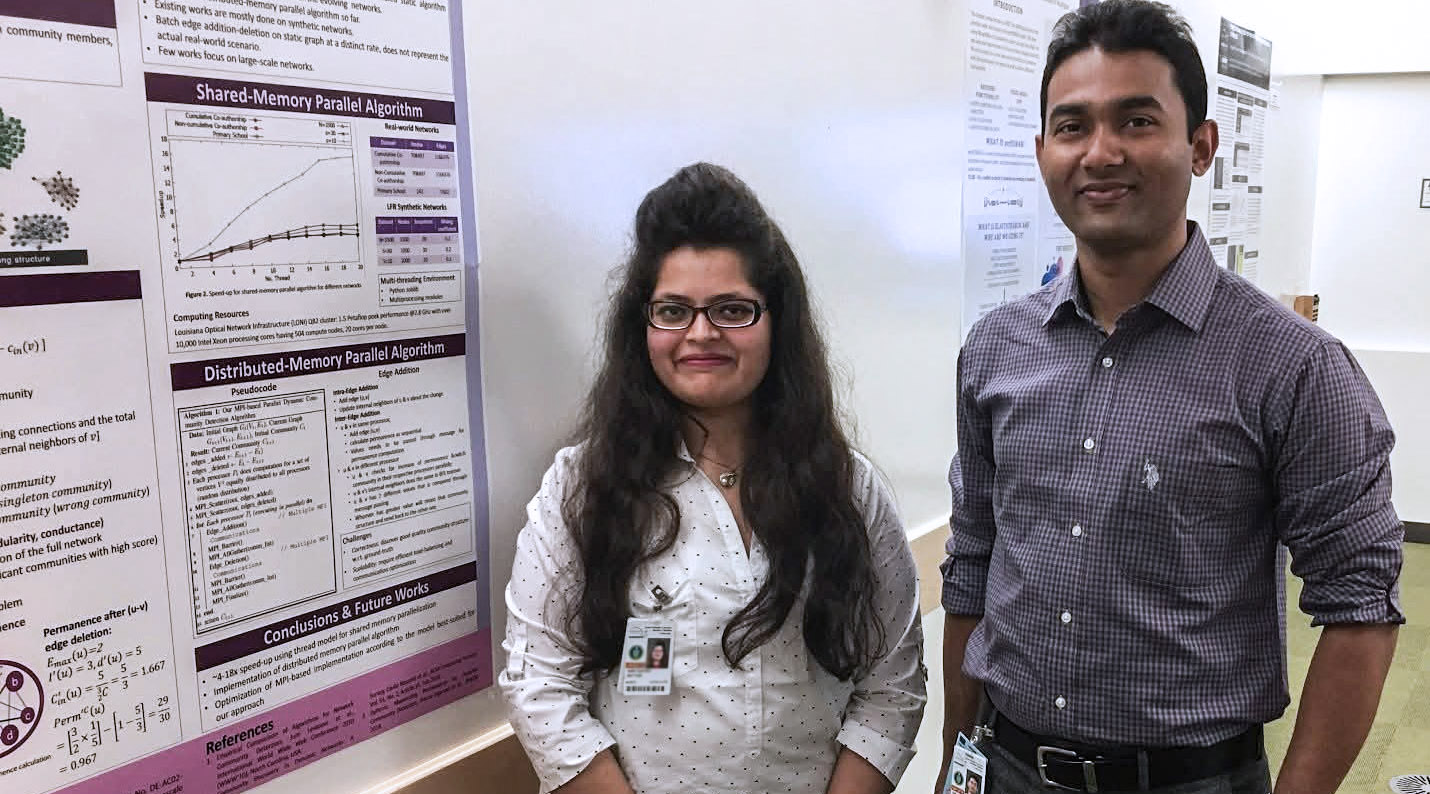
A standout achievement among these publications was their 2023 Applied Network Science paper introducing DyComPar, a highly scalable algorithm rooted in their original summer research. After testing six different approaches to dynamic community detection, the team discovered that a localized, vertex-centric optimization method performed just as well as classical models but was uniquely suited to parallel computing. Capitalizing on this insight, they designed DyComPar to split the computational work across multiple processing threads simultaneously. When tested on a multi-core machine, their algorithm successfully processed complex graph data between four and eighteen times faster than previous methods.
Over the years, Ibrahim watched Sattar transition to a postdoctoral position at Oak Ridge National Laboratory and eventually become an assistant professor of HPC at Meharry Medical College. This year, Sattar participated in the SRP matching workshop again, but this time as a faculty member. She once again matched with Ibrahim, who supported her successful application,, securing DOE funding that allowed her to return to the Lab.
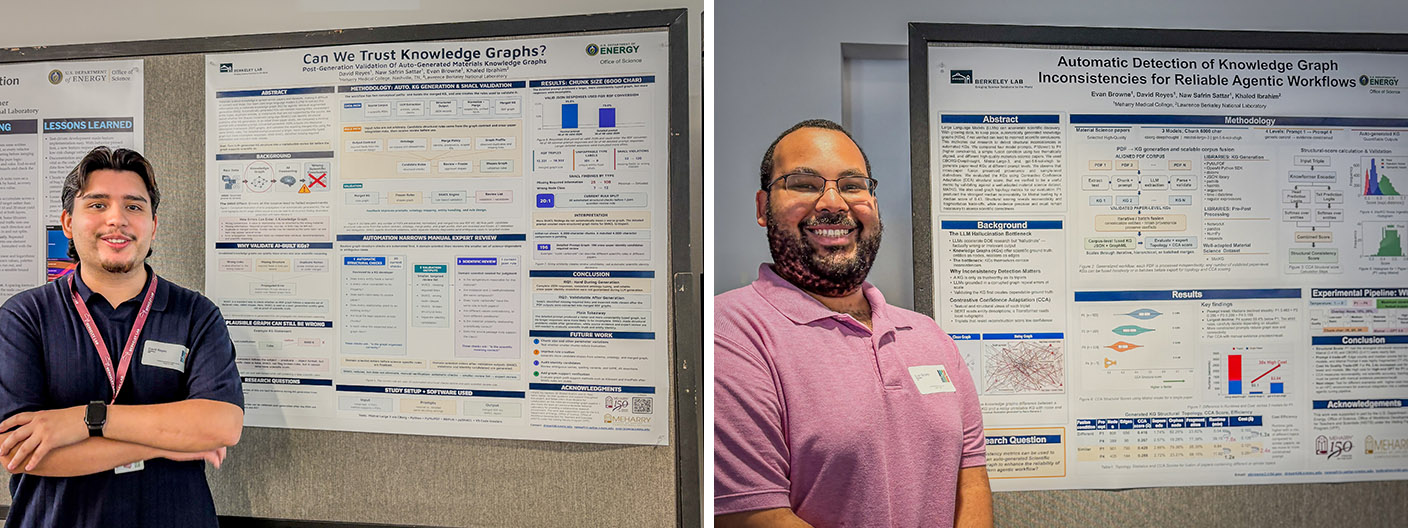
Rather than just continuing their past work, Sattar and Ibrahim are using this summer to pivot toward new frontiers. Their team is currently building an AI system designed to search and reason through materials science research to help scientists answer complex questions. By leveraging Sattar’s graph expertise, they are pulling information scattered across various research papers and databases into one organized knowledge base. To ensure reliability, they are also building in verification checks to confirm the knowledge graph’s accuracy before the information is used.
For Reyes, one of Sattar’s graduate students, the experience provided a powerful glimpse into his future. “This internship gave me hands-on experience with HPC and a firsthand look at what research at a national lab looks like. It’s made me confident that I’d like to pursue a career in this kind of environment down the road.”
He also noted the unique benefit of having a mentor who previously stood in his exact shoes. “Because Dr. Sattar has been through it herself, she recognizes the challenges we face and has the patience to guide us through them,” said Reyes. “This summer has exceeded my expectations. I’ve had the chance to grow and learn so much from the people here at Berkeley Lab. My mentors have given me a lot of room to explore and contribute my own ideas, and they’ve always provided thoughtful feedback and direction.”
“This is the first time I’ve ever had a student-professor-mentor relationship in my academic experience, and the dynamic was quite refreshing,” said Browne, Sattar’s other graduate student. “It was established early on that we are here to learn, which made me entirely comfortable asking questions and getting thought-provoking insights from Dr. Ibrahim. Coming from a biomedical background, I found that diving into materials science data has really shaped my interest in HPC research. As I finish my master’s, this overall experience has encouraged me to keep an open mind to any new career opportunity that catches my interest.”
For Ibrahim, seeing Sattar return with her own mentees is the ultimate success story, fulfilling the exact purpose he believes these programs serve.
“Through my participation in the VFP program as a mentor, I’d like people to know a bit about national labs and hopefully, long term, this could yield an interest in working at one,” said Ibrahim. “At least they will know what it offers, see how things work internally, and not be scared to consider applying.”
About Computing Sciences at Berkeley Lab
High performance computing plays a critical role in scientific discovery. Researchers increasingly rely on advances in computer science, mathematics, computational science, data science, and large-scale computing and networking to increase our understanding of ourselves, our planet, and our universe. Berkeley Lab's Computing Sciences Area researches, develops, and deploys new foundations, tools, and technologies to meet these needs and to advance research across a broad range of scientific disciplines.