
News

Novel Family of Conditional Generative Models Uses AI-Generated Earthquake Simulations to Improve Disaster Preparedness
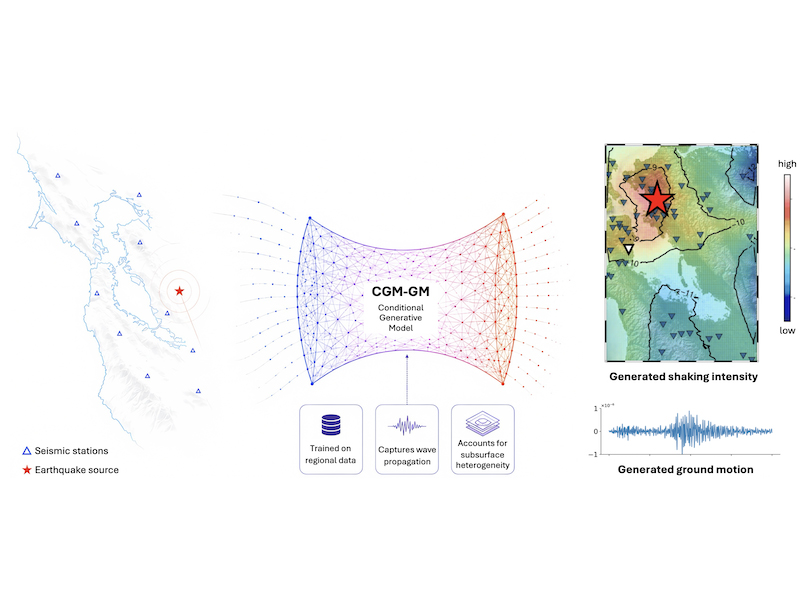
A three-part diagram illustrating the workflow of the Conditional Generative Modeling for Ground Motion (CGM-GM) AI model. The left section shows a map of the San Francisco Bay Area with a red star marking an earthquake source and blue triangles representing seismic stations. The middle section features a three-dimensional, hourglass-shaped wireframe representing the CGM-GM model, compressing blue input data on the left into a narrow bottleneck and expanding it into red output data on the right. Below the model, three text boxes with icons indicate the system is trained on regional data, captures wave propagation, and accounts for subsurface heterogeneity. The right section displays the model's outputs: a heat map showing generated shaking intensity radiating from the earthquake source, with a color scale ranging from blue for low intensity to red for high intensity, and a line graph below it showing the detailed waveform of the generated ground motion.

Pele Combustion Simulation Suite Named R&D 100 Award Winner
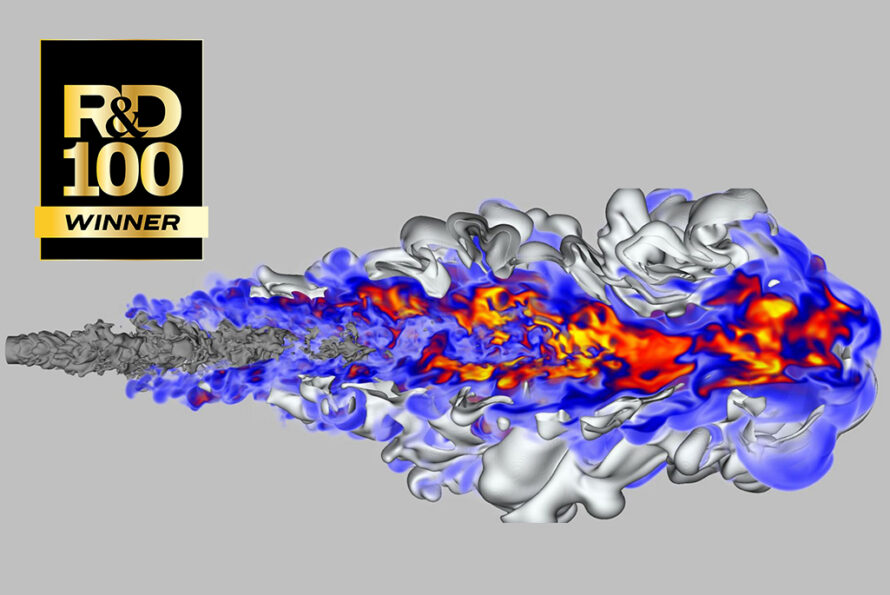
A high-resolution 3D computer simulation of a turbulent flame expanding from left to right against a light grey background. The simulation shows a textured, silver-grey plume of fuel igniting into a bright core of blue, red, orange, and yellow colors representing intense heat and complex chemical reactions. In the top left corner is a black and gold badge that reads R&D 100 WINNER.

Software Highlight: AstraAI Masters the Complex Rules of Scientific HPC Software
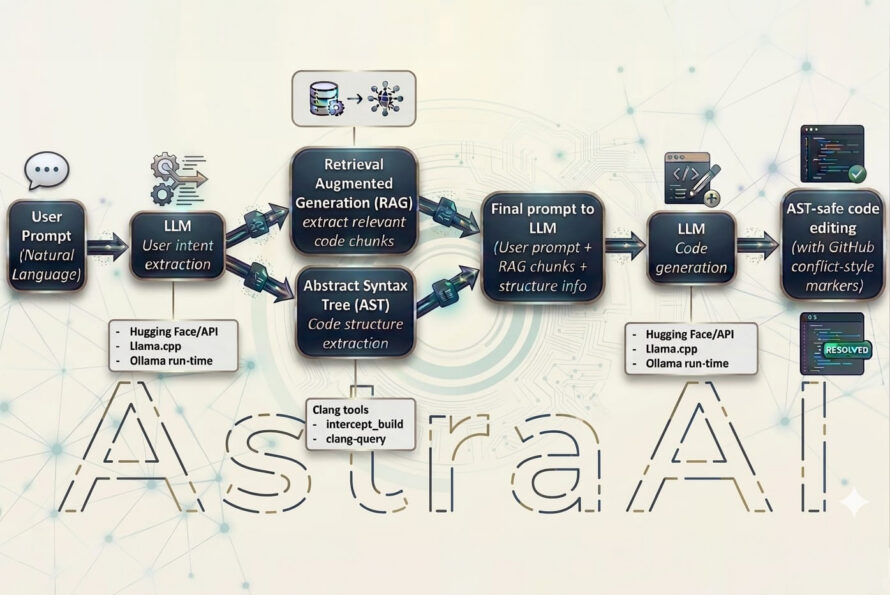
A flowchart diagram for a system called AstraAI, detailing an automated code generation pipeline that takes a natural language user prompt, extracts intent, uses RAG and AST for context and structure, generates code via an LLM, and outputs AST-safe code edits.

Meet EcoBOT: The Autonomous Lab Standardizing Plant-Microbe Research
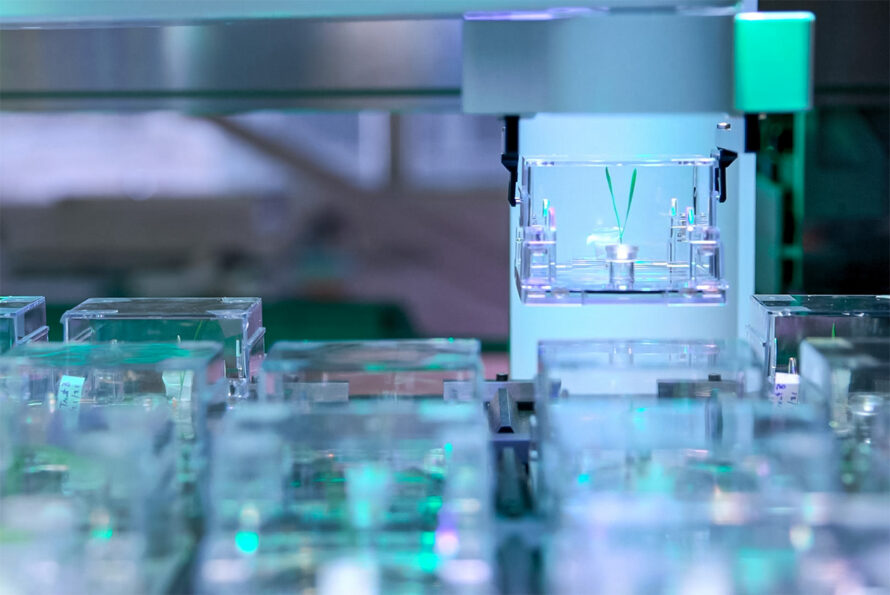
A robotic arm in a high-tech laboratory holds up a small, clear plastic container that houses a single green plant seedling. Below the raised container is an out-of-focus grid of many similar clear plastic boxes. The scene is illuminated by bright, cool blue and green lights that reflect off the plastic and metallic machinery, giving it an automated, futuristic appearance.

Scientists Develop Predictive Roadmap to Boost Performance in Next-Gen Spintronics
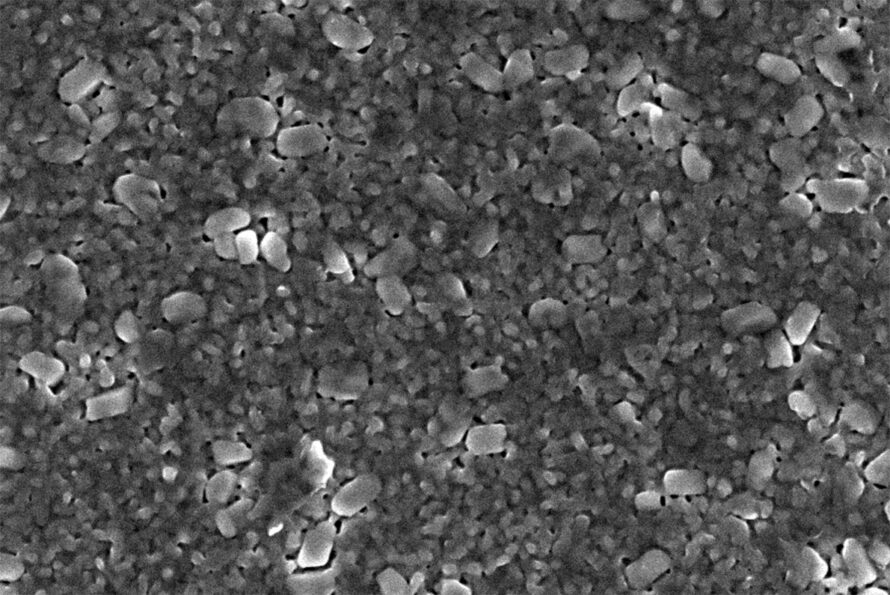
Scanning electron microscope (SEM) image of a chiral 2D metal halide perovskite material synthesized with acetonitrile. Chiral perovskite films made with acetonitrile respond strongly to circularly polarized light.

New Hybrid Approach Bypasses Hardware Limits to Unlock Complex Quantum Simulations
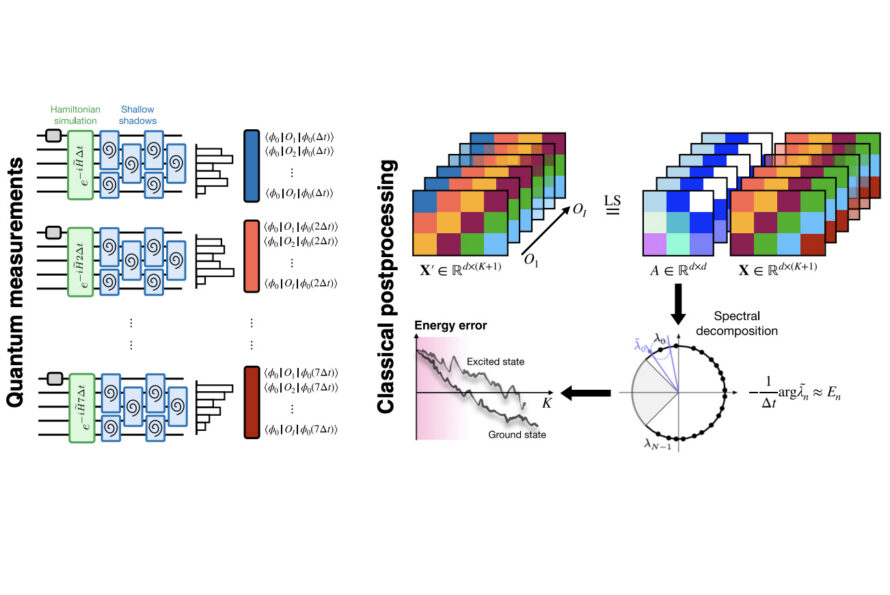
A schematic diagram divided into two main sections illustrating a computational workflow, with Quantum measurements on the left and Classical postprocessing on the right. The left section displays a series of quantum circuit diagrams at increasing time steps, featuring green blocks labeled Hamiltonian simulation and blue blocks labeled Shallow shadows, which output histograms and color-coded data vectors. The right section shows the flow of classical data processing, starting at the top with multi-layered, colorful grids representing data matrices being used to compute a central system matrix. An arrow points down from this matrix to a diagram labeled Spectral decomposition, which shows data points plotted around the perimeter of a circle to represent eigenvalues. A final arrow points left to a line graph labeled Energy error, illustrating the error rates for both an excited state and a ground state steadily decreasing as the number of data points increases.

New MatterChat Model Helps AI to ‘See’ the Language of Science
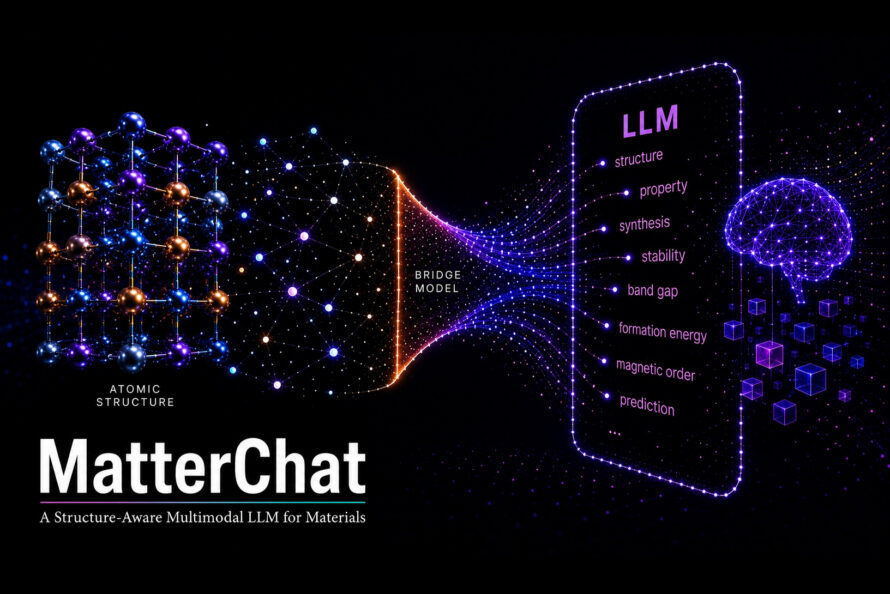
A conceptual diagram for "MatterChat: A Structure-Aware Multimodal LLM for Materials." The graphic shows a visual data flow starting from a 3D atomic structure on the left, passing through a bottleneck labeled "Bridge Model," and feeding into a digital interface labeled "LLM." The LLM interface lists various materials science terms like structure, property, synthesis, and stability, with a glowing AI brain floating on the far right.

Former NERSC Director, ALD Kathy Yelick Named Director of Berkeley Lab

OmniLearned Foundation Model Shows Promise Across Disciplines
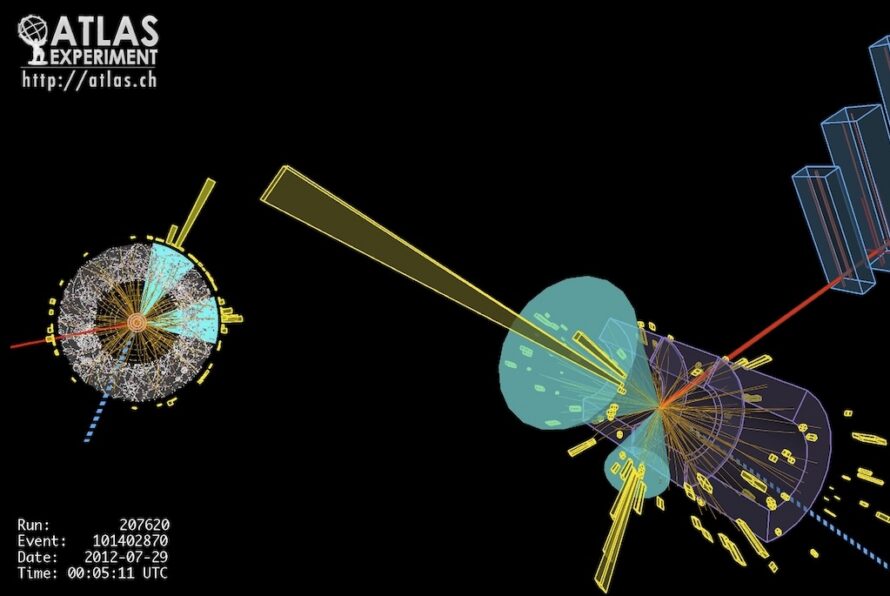
Technical image of a hadronic jet

DL4SCI 2026 to Spotlight Discovery through Agentic AI, Foundation Models
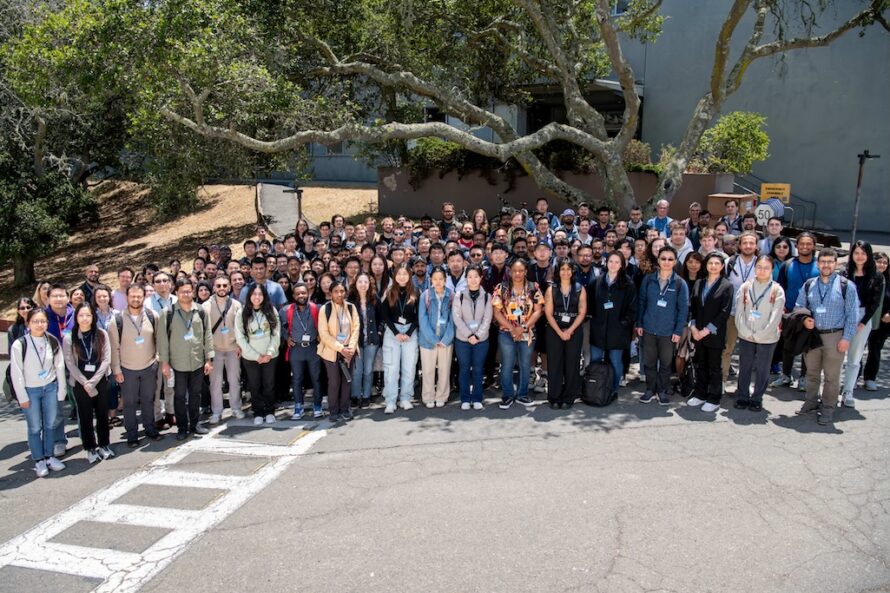
Photo of a large group of people standing under a tree at Berkeley Lab

Berkeley Lab Takes Major Step Toward Doudna with Delivery of Early Access System, Cech

Promotional image for the NERSC-10 Cech test system, featuring the name CECH and a photo of Thomas Cech.

Berkeley Lab and NVIDIA Collaboration Accelerates U.S. Leadership in Hybrid Quantum–Classical Computing
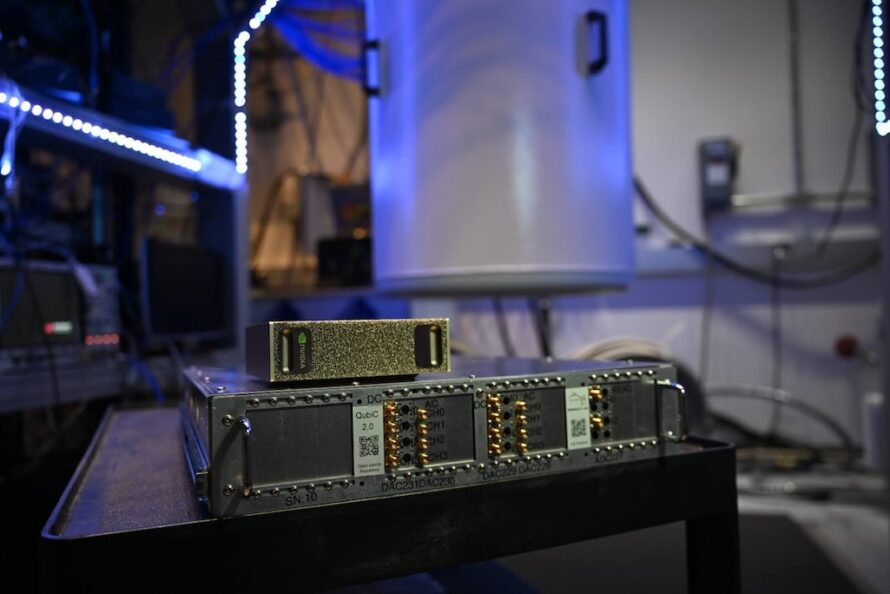

QubiC Controller
Computing Sciences logo