
Breakthrough:
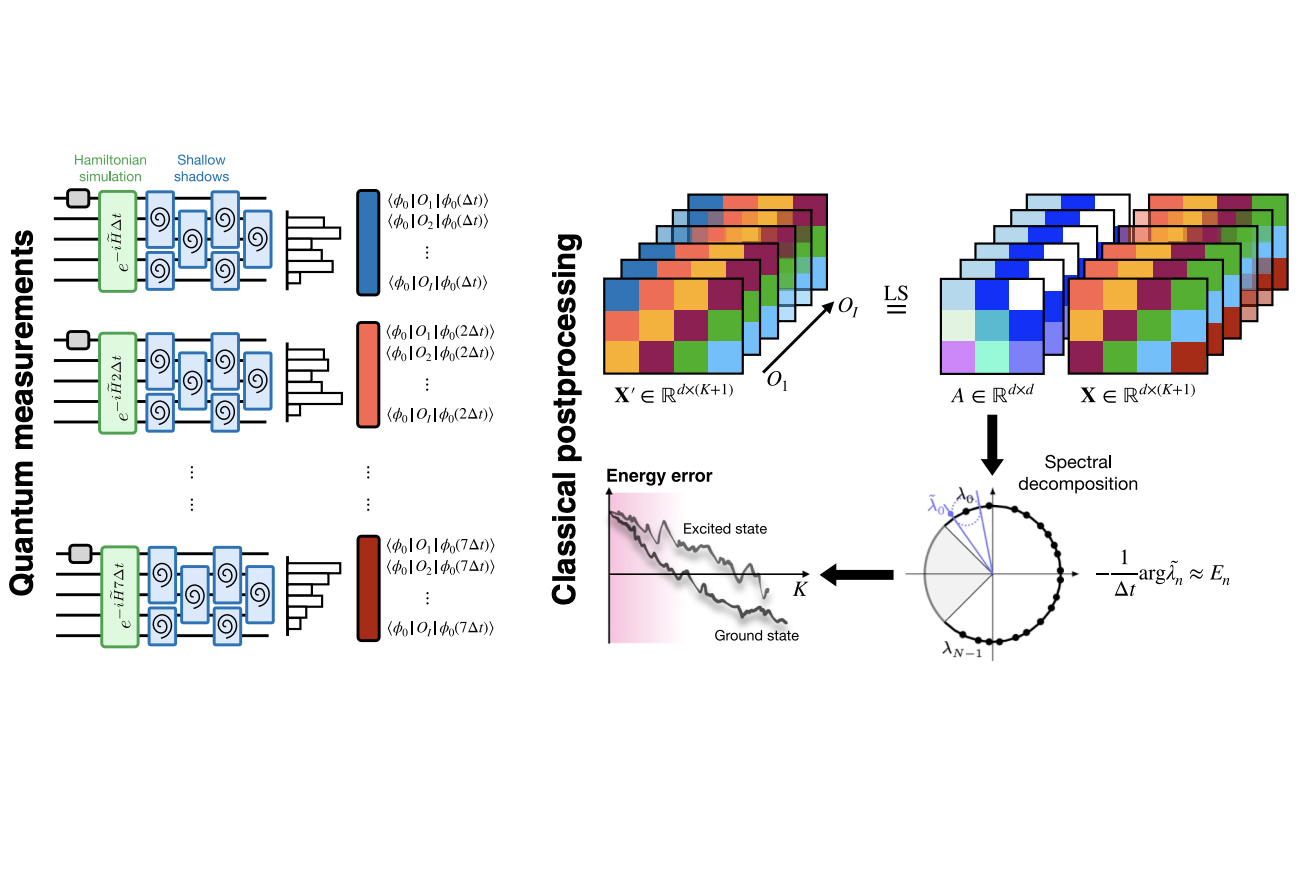
Quantum computers offer a powerful tool for discovering new materials and chemical processes. But hardware limitations have largely confined computational studies of molecules to their most basic, resting states. Berkeley Lab researchers have now developed a highly efficient hybrid framework called multiobservable dynamic mode decomposition (MODMD) to tackle this central challenge. By effectively calculating both the resting “ground” state and the “excited” energy states of quantum systems, this approach opens a practical route to spectral and dynamic information at the heart of molecular behavior. It achieves this quick, error-aware analysis using a fraction of the usual computing power. This marks a key step toward making today’s quantum computers useful for real-world chemistry and physics.
Background:
To understand how new materials behave or how complex chemical reactions occur, scientists need to calculate the various energy levels of a quantum system. While quantum computers are generally effective at simulating the lowest, most stable energy level, calculating the higher, “excited” energy levels remains extremely challenging. Traditional quantum methods require running long, continuous operations that easily overwhelm the limited capabilities of current, noise-prone quantum hardware. Finding a way to capture this vital spectral information without rapidly increasing computing time is a major roadblock for advancements in materials science and quantum chemistry.
Breakdown:
The MODMD framework overcomes these hardware limitations by creatively combining a data-analysis technique used in fluid dynamics with a highly efficient quantum measurement strategy. Instead of running many quantum simulations to map out the energy states one by one, researchers use a quantum computer to take very quick, randomized “snapshots” of a system as it evolves over time. These snapshots probe shorter quantum evolutions and require much less measurement overhead, therefore significantly reducing the burden on quantum hardware while preserving rich information. The data is then handed off to a classical computer, which stitches the signals together to accurately predict multiple energy levels and related properties of the system. By shifting the complex data analysis to classical computers, this method bypasses the resource-draining optimization bottlenecks that bog down other quantum algorithms, allowing researchers to extract a wealth of information using a fraction of the usual resources.
Co-authors:
Yizhi Shen (Berkeley Lab), Alex Buzali (Harvard), Hong-Ye Hu (Harvard), Katherine Klymko (Berkeley Lab), Daan Camps (Berkeley Lab), Susanne F. Yelin (Harvard), and Roel Van Beeumen (Berkeley Lab).
Publication:
Efficient Measurement-Driven Eigenenergy Estimation with Classical Shadows
Funding:
Department of Energy Office of Advanced Scientific Computing Research (ASCR) Exploratory Research for Extreme-Scale Science
User Facilities:
This research used computing resources of the National Energy Research Scientific Computing Center (NERSC).
About Computing Sciences at Berkeley Lab
High performance computing plays a critical role in scientific discovery. Researchers increasingly rely on advances in computer science, mathematics, computational science, data science, and large-scale computing and networking to increase our understanding of ourselves, our planet, and our universe. Berkeley Lab's Computing Sciences Area researches, develops, and deploys new foundations, tools, and technologies to meet these needs and to advance research across a broad range of scientific disciplines.