
Breakthrough
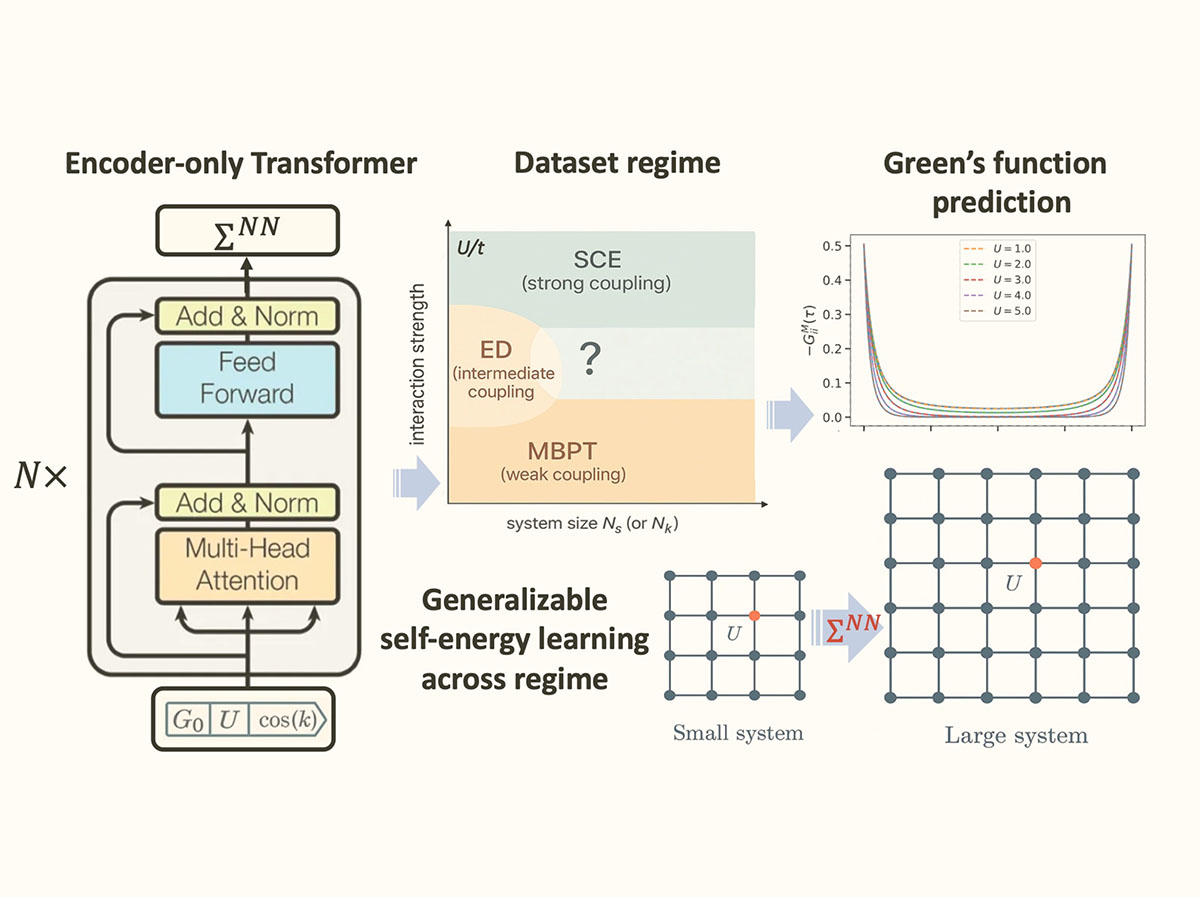
Berkeley Lab researchers have developed Σ-Attention (Sigma-Attention), a new AI framework that overcomes the massive computing roadblocks of simulating complex quantum systems. To capture the essential physics, the team used a “cocktail of methods”—combining data from three distinct simulation techniques to train a single AI model. While these traditional techniques each work only under very specific physical conditions, the unified Σ-Attention model accurately predicts the collective behavior of interacting electrons across all conditions.
By proving its accuracy on a standard quantum test model, the researchers demonstrated that Σ-Attention can drastically reduce the massive computing power typically required for complex quantum simulations while maintaining accuracy. This leap in efficiency paves the way for a fast, unified tool to simulate larger, realistic quantum materials for next-generation energy and quantum technologies.
Background
Many emerging quantum materials owe their remarkable properties to “strongly correlated” electrons. In these materials, the mutual repulsion between electrons—known as Coulomb interactions—is so intense that the electrons can no longer be treated as independent particles. Instead, they behave collectively, giving rise to phenomena such as high-temperature superconductivity, magnetism, and metal-insulator transitions. Understanding this collective behavior is essential for developing future quantum technologies and could ultimately enable transformative applications, including lossless power transmission, ultra-efficient computing, and advanced quantum sensors.
Accurately simulating these materials, however, remains one of the grand challenges in modern physics. Traditional computational methods force researchers into trade-offs. Many existing formulas rely on approximations that are only reliable when electron interactions are relatively weak, while the most accurate approaches require so much computing power that they can only simulate incredibly tiny systems. Scientists have long searched for a new way to model these materials—a tool like Σ-Attention that combines broad physical applicability with high computational efficiency.
Breakdown
To build Σ-Attention, the research team adapted a transformer—the same AI architecture powering modern large language models—to solve a physics problem. Instead of predicting the next word in a sentence, this transformer learns to predict “self-energy,” a mathematical function that captures how electrons influence one another within a material.
The researchers trained the model using data from three traditional approaches: many-body perturbation theory, strong-coupling expansion, and exact diagonalization. By synthesizing these diverse datasets, the transformer learned a unified representation of the physics, enabling accurate predictions across a much broader range of conditions than any single method alone.
When tested on the Hubbard model—a benchmark for strongly correlated materials—Σ-Attention accurately reproduced key behaviors, including the transition from a conducting metal to an insulator. Crucially, it also solved the field’s scaling problem. Unlike conventional methods that hit a computational wall as systems grow, the AI framework scales efficiently, allowing simulations of significantly larger systems. Looking ahead, the team will tackle more complex scenarios, including varying temperatures, states away from half-filling, and realistic two- and three-dimensional quantum materials. Successfully modeling these intricate, real-world conditions is a critical next step toward designing practical materials for advanced energy systems and future quantum computing devices.
Co-authors
Yuanran Zhu (Berkeley Lab), Peter Rosenberg (Flatiron Institute), Zhen Huang (UC Berkeley), Hardeep Bassi (UC Merced), Chao Yang (Berkeley Lab), and Shiwei Zhang (Flatiron Institute).
Publication
Transformer-based operator learning framework for self-energy in strongly correlated systems
Funding
Department of Energy Scientific Discovery through Advanced Computing (SciDAC),
Center for Computational Study of Excited-State Phenomena in Energy Materials (C2SEPEM)
Simons Foundation Grant in Mathematics and Physical Sciences on Moire Materials Magic
User Facilities
This research used National Energy Research Scientific Computing Center (NERSC) computing resources.
About Computing Sciences at Berkeley Lab
High performance computing plays a critical role in scientific discovery. Researchers increasingly rely on advances in computer science, mathematics, computational science, data science, and large-scale computing and networking to increase our understanding of ourselves, our planet, and our universe. Berkeley Lab's Computing Sciences Area researches, develops, and deploys new foundations, tools, and technologies to meet these needs and to advance research across a broad range of scientific disciplines.