
News

Software Highlight: Fiats Brings Deep Learning to Fortran at Supercomputer Scale

An ASCII art representation of the word 'FIATS' created using various keyboard characters, with the text 'Fiats: Functional Inference and Training for Surrogates' displayed below. The design emphasizes a playful and creative approach to presenting the name of the software framework focused on functional inference and training.

Software Highlight: Julienne and Assert Strengthen Fortran Code Reliability

Software Highlight: Caffeine Supercharges Fortran for the Exascale Era

A graphic representation of a coffee cup with layered components illustrating a software architecture. The layers from top to bottom include: 'Compiled Application,' 'PRIF,' 'Caffeine,' and 'GASNet-EX.' The base of the cup is labeled 'System Runtime & Memory Technologies,' indicating the foundational technologies that support the application.

Berkeley Researchers Receive IEEE Best Paper Award for Exascale Software Insights
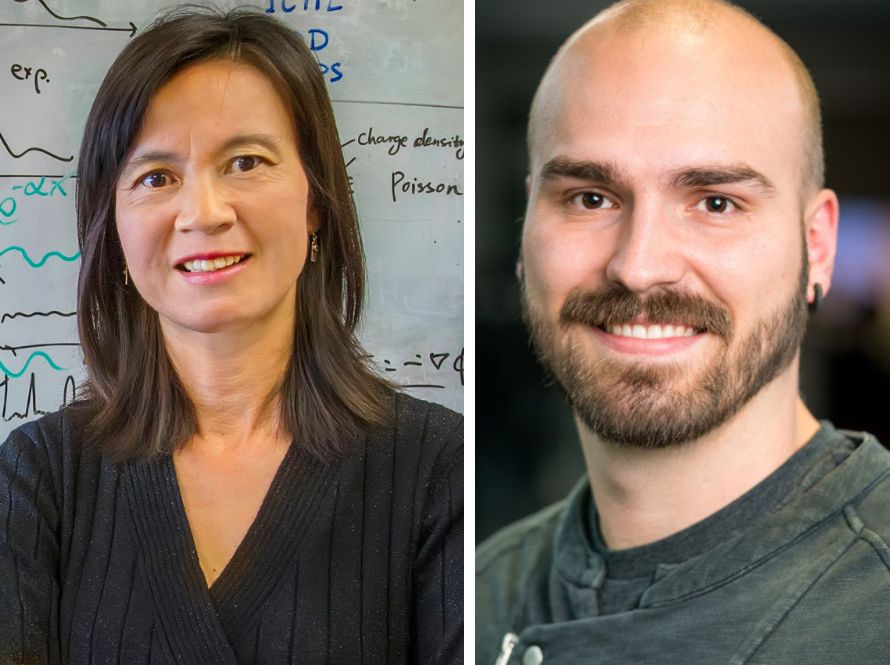
The image features two individuals side by side. On the left, a person with shoulder-length dark hair is wearing a black, textured top and stands in front of a whiteboard filled with scientific equations and diagrams. On the right, another person with a shaved head is wearing a gray hoodie. The background appears to be a dimly lit environment, possibly an indoor space.

Berkeley Researchers Advance Fluid Flow Modeling for Better Energy Production
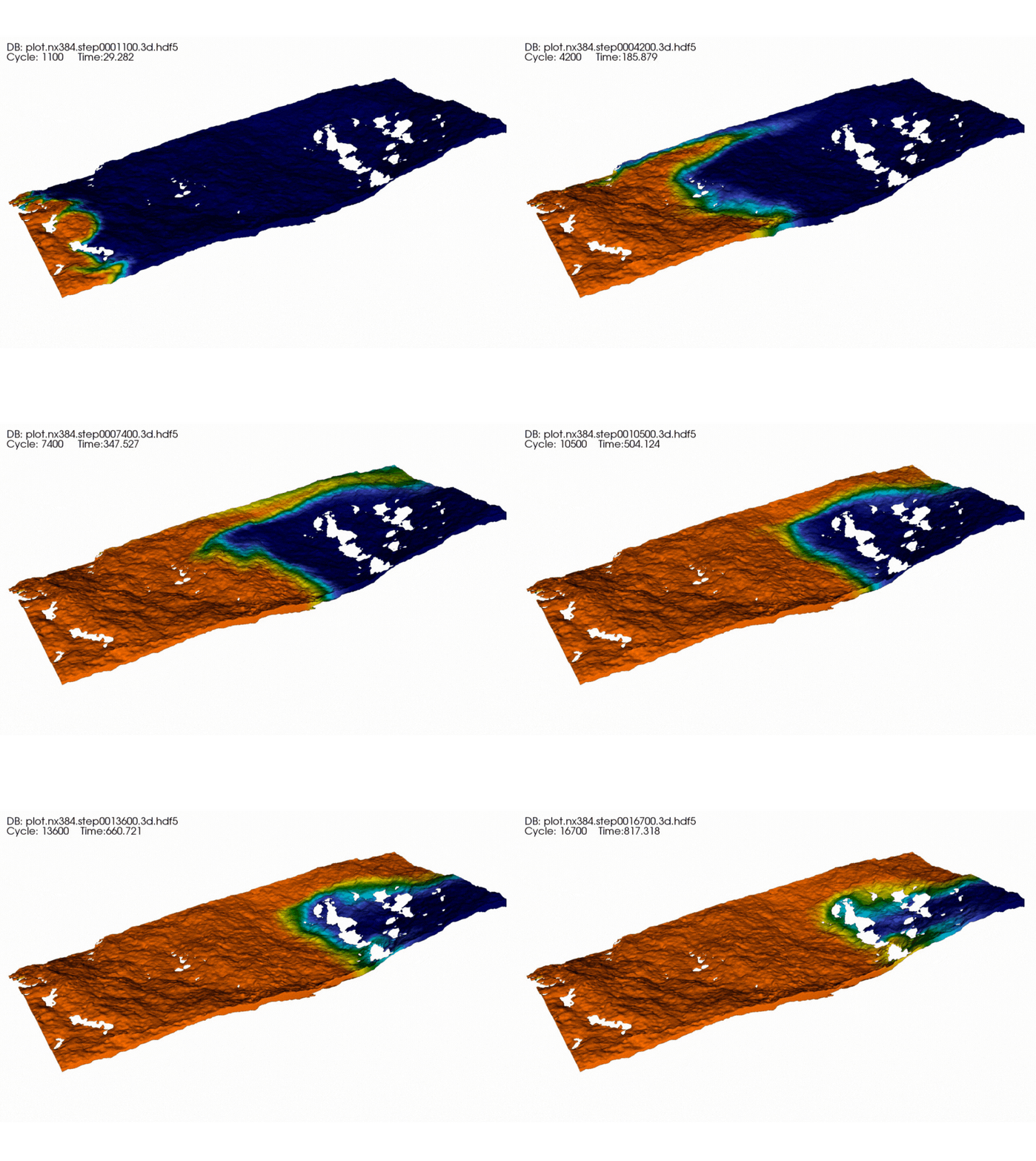
Simulation showing a 3D model of fluid flow through fractured subsurface dolomite, with color indicating different regions or properties within the flow.

Machine Learning Breakthrough Transforms Battery Lifespan Prediction
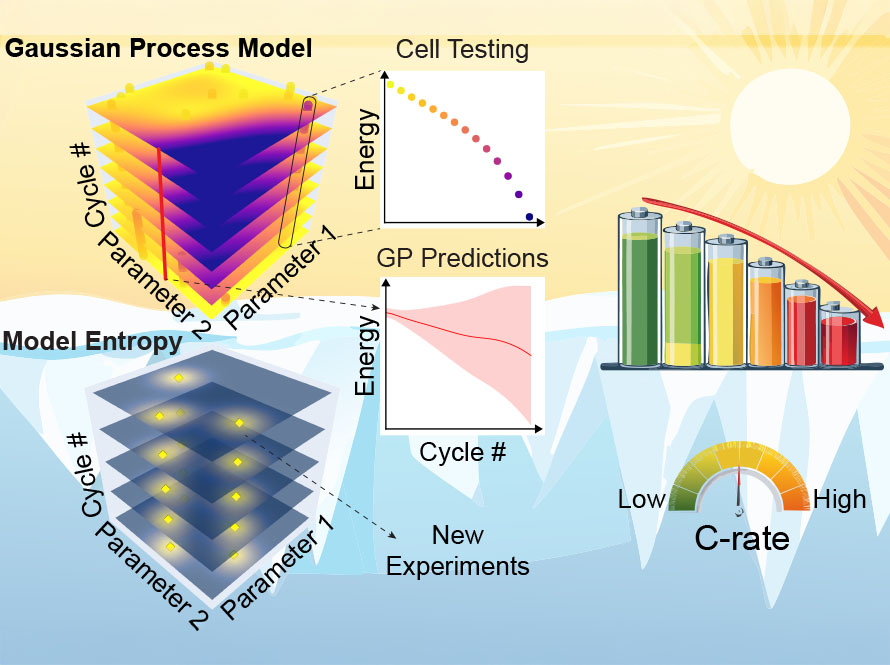
Illustration showing a machine learning framework for battery testing: a Gaussian Process model visualizes battery energy predictions across cycles and parameters, with model entropy highlighting areas of uncertainty for new experiments; additional graphics show cell testing results, predicted energy decline, and a gauge indicating battery C-rate from low to high.

Science Highlight: Breakthrough Computing Method Speeds Up Big Calculations for Science and Engineering
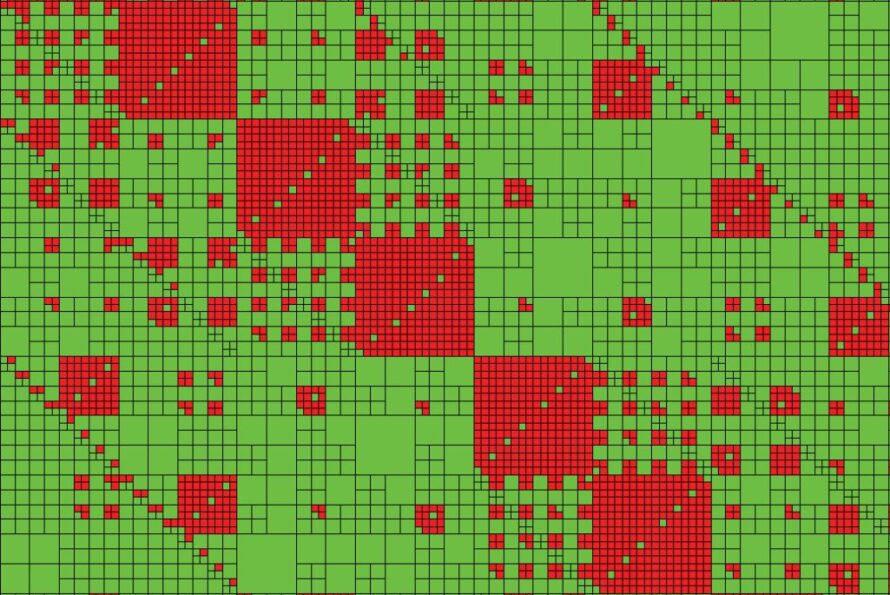
Color-coded matrix diagram illustrating the H2 matrix representation of a 3D Boundary Element Method (BEM) matrix, with red blocks indicating fully formed matrix sections and green blocks showing low-rank compressed regions in a nested structure.

Meet Mark Fornace, Berkeley Lab’s 2025 Alvarez Fellow

A person standing outdoors in front of tall evergreen trees, with sunlight filtering through the branches.

Computational Chemistry Unlocked: A Record-Breaking Dataset to Train AI Models has Launched
Computing Chemistry Color Geometric Shape

Berkeley Lab Researchers Awarded ARITH 2025 Best Paper
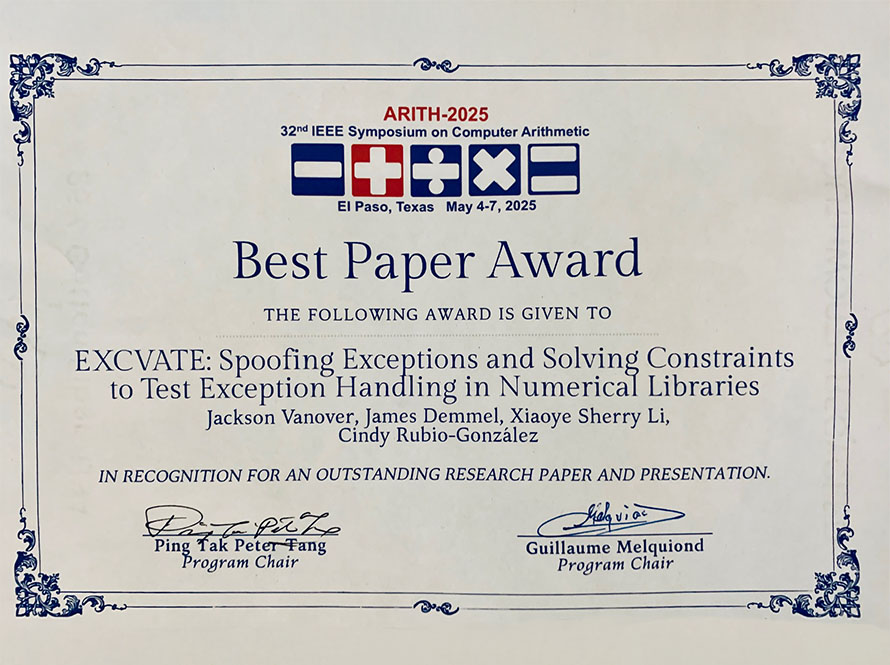
Certificate for the Best Paper Award at the 32nd IEEE Symposium on Computer Arithmetic (ARITH-2025), held in El Paso, Texas, May 4–7, 2025. The award is given to Jackson Vanover, James Demmel, Xiaoye Sherry Li, and Cindy Rubio-González for the paper titled "EXCVATE: Spoofing Exceptions and Solving Constraints to Test Exception Handling in Numerical Libraries." The certificate is signed by Program Chairs Ping Tak Peter Tang and Guillaume Melquiond.

AMCR’s Stefan Wild Named 2025 SIAM Fellow

Berkeley Lab Researchers Help Shape the Future of AI in Biological Research


A large group of people standing on a staircase inside a building, posing for a group photo. The setting includes indoor plants and modern architectural elements.
Computing Sciences logo