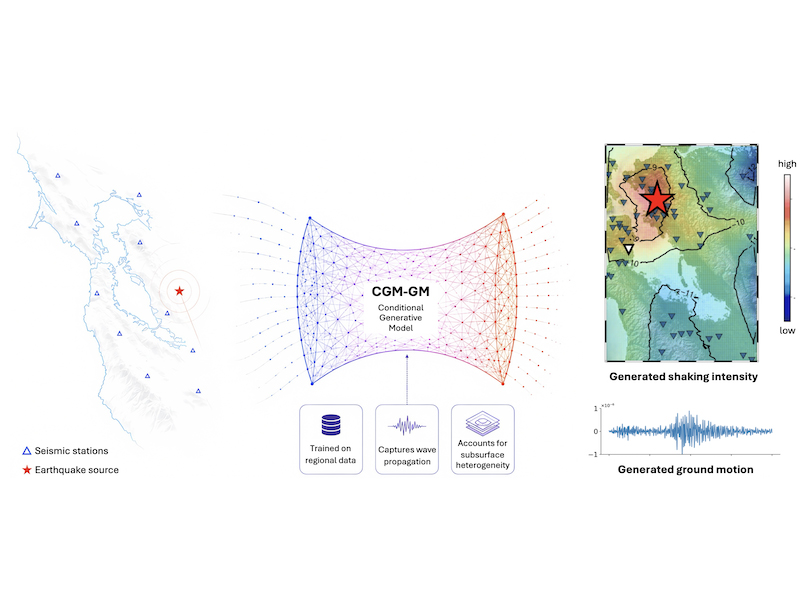
A comparative infographic showcasing the results of different generative AI models in creating scientific images. The infographic is divided into three vertical sections, labeled 'Ceramics,' 'Plants,' and 'Rocks.' Each section contains a grid of images comparing a 'Raw' scientific source image to AI-generated versions created by models including DCGAN, StyleGAN, DALL-E2, and DALL-E3. The 'Ceramics' section shows microscopic views of packed particles, the 'Plants' section displays images of seedlings and root systems, and the 'Rocks' section features grayscale micro-scans of rock sediment, illustrating the varying success of different AI models in reproducing scientifically accurate images. A scientific diagram showing a four-step simulation. Step (a) shows a system of water molecules with an excess electron. Step (b) shows a simplified representation of a single water molecule. Step (c) is a heat map of the system's electrical potential. Step (d) shows the final calculated probability cloud of the electron, derived from the potential in (c). Decorative image with holly berries and leaves and the text "Happy Holidays from Berkeley Lab's Computing Sciences Area" Close-up view of a quantum computer’s superconducting processor housed within a cylindrical, gold-colored cryogenic chamber, featuring multiple stacked plates connected by intricate wiring and metallic rods. Four-panel visualizations for three different physical systems are arranged in three rows, labeled (a), (b), and (c). Each row corresponds to a specific system: (a) plasma turbulence (MHD), (b) fluid flow (Navier-Stokes), and (c) shallow-water dynamics. Within each row, the panels display (from left to right): the ground truth state, the StFT-F model prediction, the spatial distribution of prediction error (residual), and the predicted uncertainty. Colorbars beside each panel indicate the value ranges, with red and blue representing positive and negative values. The visualizations show that areas with higher errors generally coincide with regions of higher predicted uncertainty. Digital simulation generated with the WarpX code depicts blue and yellow shockwaves against a black background. A large group of people pose together for a group photo in front of a modern building labeled "SHYH WANG HALL 59." The group is diverse, including men and women of various ages, and some people are wearing conference badges. The photo was taken on a sunny day, and the building features large windows and gray metal paneling. A group of individuals stands on a stage beneath a large "SC25" sign with a purple dynamic background; several people hold award certificates, and others stand in formal or business attire.
Computing Sciences logo